
Tips for Moving From Consulting to Industry

The following post features Tips for Moving From Consulting to Industry.
Shifting from consulting to an in-house role? You need to communicate the details of your various consulting engagements in a compelling way that highlights your transferable skills to make the shift.
Read: Pros and Cons of Being Political on LinkedIn (for Job Seekers)
Related: Finding Your Ideal Career (with PDF Worksheet)
Successfully transitioning from consulting to an in-house leadership role requires taking a holistic approach that allows you to spread your messaging across multiple mediums.
Here’s what you need to know.
Overview
Transitioning from a management consulting role to an in-house position can be tricky. The project-based nature of consulting makes it challenging when it comes to effectively communicating your experience.
To successfully bridge the gap between the short-term nature of consulting and the more structured demands of an in-house role, you need to leverage not just your Resume, but also your Cover Letter, LinkedIn profile, and Addendum (as needed).
Each of these tools serves a unique purpose in helping to convey how your consulting experience aligns with the responsibilities and expectations of an in-house position.
As you consider going in-house this Reddit discussion explores the topic of whether ‘the grass is greener’ on the other side.
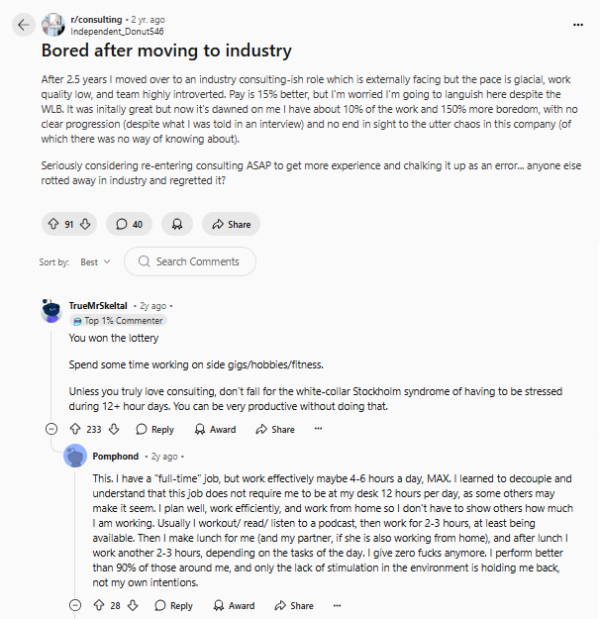
Pictured: Screenshot of a Reddit discussion about going from consulting to industry.
Resume
Making the transition from consulting to corporate calls for a Resume that documents your consulting experience effectively. It needs to be ATS-friendly, visually appealing, and no longer than two pages.
You must reflect on your consulting experience and identify the top 3-5 consulting projects that you want to focus on. Quality over quantity is everything when it comes to your Resume. Don’t try to cram 10 different projects on a two page Resume. You’re better off with three really strong ones.
When building your Resume you should also make sure to communicate the three pillars of your professional experience – that means your occupation, seniority level, and industry expertise.
Cover Letter
Your Cover Letter must bridge the gap between your consulting experience and in-house opportunities.
Since you’re looking to make this leap from the consulting side, it’s wise to make clear that you’re deliberately looking to shift from consulting to industry.
To that end, communicating the context and narrative behind your situation is key. For example, your desire to focus on the long-term, in contrast to the short-term nature of consulting assignments.
Addendum
Sometimes, building an Addendum to your Resume makes sense when shifting from consulting to in-house.
The Addendum is basically a place for listing all the consulting engagements that didn’t make it onto your two-page Resume due to a lack of space.
It is not part of your Resume, but rather it’s furnished alongside your Resume as a separate document.
LinkedIn Profile
In a world where Resumes are getting shorter and shorter – your LinkedIn profile is key for highlighting the breadth and scope of your experience.
For example, adding projects on LinkedIn is one of the best strategies for documenting all of your consulting experience. Space is not a limiting factor on your LinkedIn profile like it is on a Resume. The projects section is great for adding long-form content in a neat and orderly manner.
In addition to projects, the About section of your LinkedIn profile is key. It needs to communicate a clear message that helps employers understand your consulting experience and transferable skills.
In Conclusion
In conclusion, I hope this article helps you understand how to frame up your consulting experience to make the leap to industry. Like a jigsaw puzzle, each piece of your background fits together to form a complete picture that highlights your value to potential employers.
About the Author: Doug Levin