
Tips for Finding Your First H-1B Job
The following post explores Tips for Finding Your First H-1B Job.
Are you looking for your first H-1B job? It’s a process that comes with its own set of considerations—some obvious, others less so.
Read: Why Applying to Jobs Is a Full-Time Job
Related: Navigating H-1B Visa Changes for Job Seekers
From knowing which opportunities to focus on to understanding how timing and sponsorship factor in, there are a few key dynamics that shape how this search unfolds.
Here’s what you need to know.
Overview of H-1B Visa
The H-1B visa is a U.S. work visa that allows employers to hire foreign professionals in specialized fields such as technology, engineering, finance, and healthcare.
When searching for your first H-1B job, it’s critical to understand that not every employer is willing or able to sponsor, and even among those that do, there are internal processes that influence hiring decisions.
That dynamic shapes everything about how you approach your search.
If you’re looking for nitty gritty details about the H-1B Visa program, I recommend checking out the U.S. Citizenship and Immigration Services website.
Likewise, here is a helpful Reddit forum discussion about H-1B visa jobs.

Find Companies That Sponsor H-1B Visas
The reality is that most employers don’t sponsor H-1B visas (for a variety of reasons). Half the battle is identifying companies that actually sponsor H-1B visa candidates.
Hands down, the best resource for this is a site called H1BGrader. It allows users to conduct research and build a target list of employers who are known for hiring and sponsoring H-1B candidates.
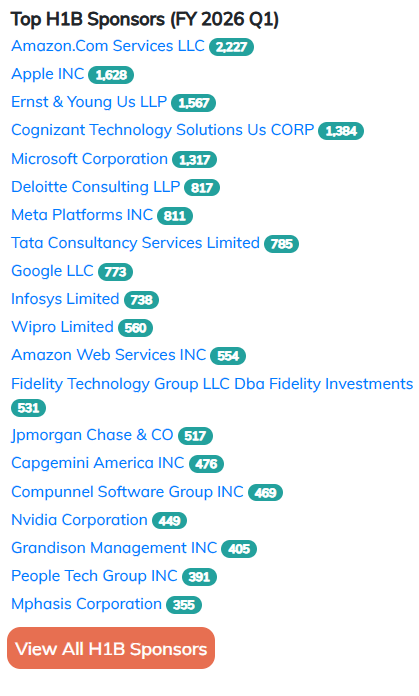
In recent years, some of the most active H-1B sponsors are Amazon, Apple, EY, Cognizant, Microsoft, and Deloitte. Below is a screenshot of top H-1B sponsors according to H1BGrader.
👉 Top H-1B Companies
Pay Close Attention to Timing
Timing plays an outsized role in the H-1B process.
Unlike a typical job search that can unfold organically, H-1B hiring is tied to a structured annual cycle. The registration window generally opens in March, which means employers need to be prepared to act well in advance of that date.
As a result, your job search should begin months earlier (ideally 6-9 months before you need sponsorship). For many students, this aligns with their final academic term or the early stages of OPT.
Starting early is less about being proactive and more about staying viable within the system’s constraints.
Understand the Cap and Lottery
Another important piece of the puzzle is the annual cap on H-1B visas.
Each year, there are more applicants than available slots, which has led to a lottery system for determining who moves forward. Even strong candidates with job offers are not guaranteed selection, and it is not uncommon to go through multiple cycles before being chosen.
For example, imagine 300,000 people apply for 85,000 available H-1B slots in a given year. Even if you graduate from a strong university, earn excellent grades, and secure a legitimate job offer from a respected employer, there is still a significant chance your application will not be selected simply because of the numbers involved.
This is one reason many international graduates try to position themselves strategically by targeting employers familiar with the H-1B process, applying broadly, and starting the search early.
Be Strategic About Your Target
The H-1B process is designed for specialized roles.
Certain industries (i.e. technology, engineering, finance, etc) tend to sponsor more frequently because the roles are often tied to high-demand skill sets. Candidates who position themselves within in-demand, skill-based roles often have a smoother experience.
Being intentional about the types of roles you pursue can meaningfully improve your odds over time.
Prepare Your Documentation
At all costs, it’s important to avoid delays due to improper documentation.
Once an employer decides to move forward, there are specific steps that need to happen quickly. If you’re not prepared, it can slow things down or create unnecessary complications.
That’s why it’s important to have your documentation squared away. This includes academic records, identification, and anything related to your current visa status.
You don’t want to be scrambling at the last minute.
Invest in Your Resume and LinkedIn Profile
Securing H-1B sponsorship is a highly competitive process.
It’s not only competitive because of the volume of candidates, but because employers must weigh additional factors relating to the cost and complexity of sponsorship.
Nonetheless, you can improve your odds by investing in your Resume and LinkedIn profile. Starting with well-structured resume templates can help you organize your experience and achievements clearly before working with a professional writer to polish the final version.
Ultimately, the goal is to remove friction. When your skills and experience are clearly articulated across your Resume and LinkedIn profile, it becomes easier for an employer to engage with you.
In Conclusion
In conclusion, I hope you find this article helpful for finding your first H-1B job. While the H-1B process is complex and constantly evolving, hopefully this gives you a solid foundation and some practical food for thought as you move forward.
Looking to invest in a professionally written Resume and LinkedIn profile for your H-1B applications? Please fill out the Contact Us form or Submit Your Resume for a risk-free evaluation. JobStars is an A+ BBB-rated service with multiple consecutive Complaint Free Awards. We look forward to hearing from you!
About the Author: Doug Levin