

How to Show Interest in Internal Roles on LinkedIn

The following post explores How to Show Interest in Internal Roles on LinkedIn.
Have you ever wanted an easier way to let internal recruiters know you’re interested in a new role within your company—without having to formally apply or start a conversation before you’re ready?
Whether you’re aiming to move into a different job title, step into a more senior role, or even relocate to another city where your company has an office, LinkedIn’s new tool makes that easy to communicate.
Here’s what you need to know.
Overview
LinkedIn has a feature that lets you signal interest in internal opportunities at your current company.
Think of it as the internal version of “Open to Work”—but instead of alerting external recruiters, you’re alerting recruiters at the company you currently work for.
The real advantage here is convenience: it gives you a simple way to indicate interest to internal recruiters without the formality of applying or initiating a conversation before you’re ready.

How it Works
Similar to the “Open to Recruiters” setting, this feature can also be accessed near the top of your profile in the “Open to” section.
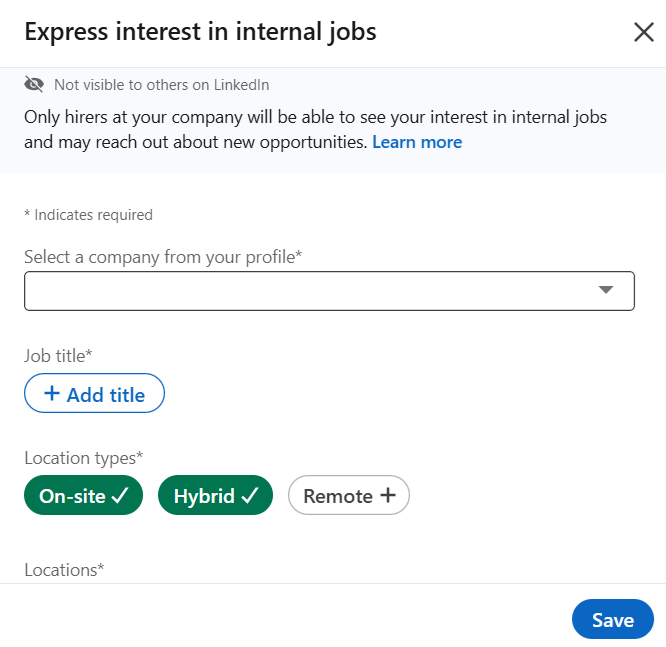
Once enabled, you’re prompted to define what you’re interested in, including selecting up to five target job titles, indicating your preferred work setup—such as onsite, hybrid, or remote—and choosing up to five geographic locations where you’d be open to working.
After that, the information becomes visible to internal recruiters using LinkedIn’s hiring tools. If a recruiter is searching for candidates and your profile aligns with what they’re looking for, you may show up as someone who has already expressed interest. From there, they might reach out to start a conversation, keep you in mind for a current opening, or consider you for a role that comes up in the future.
Pictured below is a screenshot from LinkedIn on setting this up.
A Real-World Example
To see where this becomes useful, consider a common scenario.
Imagine working as a Project Manager in New York at a large company with offices across the country. You’ve been thinking about relocating to San Diego for personal reasons, and at the same time, you’re ready to step into a more advanced role, such as Senior Project Manager or Program Manager.
In that situation, the challenge isn’t just finding the right opportunity—it’s making the right people aware that you’re interested in that kind of move. You may not want to apply to roles prematurely or start conversations before you have something concrete, but without taking some kind of action, internal recruiters have no way of knowing what you’re looking for.
This is where the feature becomes useful. By selecting target roles like Senior Project Manager or Program Manager, indicating openness to hybrid or remote work, and choosing San Diego (along with a few other cities) as preferred locations, you’re creating a clear signal of your intent.
If an internal recruiter is hiring for a role that matches those criteria, you’re more likely to appear as someone worth considering. That can lead to a conversation, being evaluated for a current opening, or simply being on their radar for future roles that align with what you’ve outlined.
Benefits
The primary advantage of this feature is that it creates visibility without requiring immediate action.
Employees can express interest in new roles, locations, or career paths without formally applying or initiating potentially sensitive conversations too early. It also helps surface opportunities that may not be obvious, particularly in large organizations where roles are distributed across different teams and regions.
From the employer’s perspective, it strengthens the internal talent pipeline by identifying employees who are already thinking about their next move, making it easier to retain talent that might otherwise begin exploring external opportunities.
Drawbacks
At the same time, there are important limitations to keep in mind.
This feature does not replace formal internal hiring processes, and in many organizations, applications, referrals, and direct conversations will still carry more weight. Its effectiveness also depends if internal recruiters are actively using these tools or not.
There is also a perception factor. Even though the feature is designed to be private, some employees may hesitate to use it out of concern that signaling interest could be interpreted as dissatisfaction with their current role, especially in more tightly managed environments.
In Conclusion
In conclusion, I hope you find this article helpful for exploring LinkedIn’s internal role interest signal. It’s a thoughtful addition that helps close a long-standing gap between employees and internal recruiters. It won’t replace traditional processes, but it does introduce a new layer of visibility. For professionals working within larger organizations, it’s a simple tool worth using.
If you’re ready for professional assistance with building your new LinkedIn profile, we’re here to support you. Please use the Contact Us or Submit Your Resume for a risk-free evaluation. JobStars is an A+ BBB-rated service that has earned multiple consecutive Complaint Free Awards.
About the Author: Doug Levin