

Why Large Job Boards Are a Trap
The following post explores Why Large Job Boards Are a Trap.
In the digital age, large job boards like Indeed, LinkedIn, Monster, and Glassdoor have become the default starting point for millions of job seekers.
Read: Staying Top of Mind After the Interview (With PDF Tip Sheet)
Related: How to Build a Target Employer List
However, when applying to postings on these sites becomes your main or only strategy, you’re unintentionally narrowing your options more than you might think.
Here’s what you need to know.
Overview
Many job seekers are over reliant on large job boards.
It’s an understandable phenomenon. Life is busy. Finding jobs that match your criteria is a chore. Plus, these large job boards do everything they can to be as convenient and user friendly as possible.
The problem is it’s the easiest thing possible. Using large job boards is the path of least resistance. And, as with most things in life, nothing worth having comes easy.
Don’t get me wrong, using large job boards does work. You can find real jobs from real employers. Especially if you’re diligent and fast to apply to new postings, it’s certainly possible to have success.
However, if this is your main (or only) strategy, it’s a problem. The cold hard reality is you’re facing a large pool of competition on these sites and thus severely limiting your options.
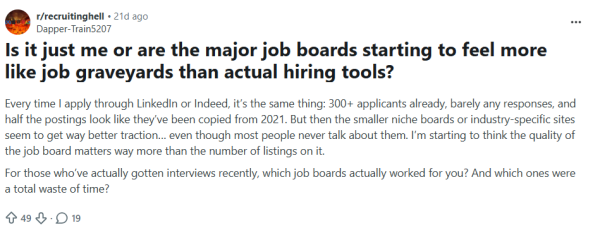
Below is a screenshot from a Reddit forum discussing large job boards and how they are problematic.
The Problem with Large Job Boards
The core issue with large job boards is the sheer volume of competition they attract.
Millions of other job seekers are doing exactly the same thing you are: logging in daily, setting up the same alerts, searching the same keywords, and rushing to apply to the same fresh postings. A single attractive role—especially if it’s remote, at a recognizable company, or in a high-demand field—can easily pull in hundreds of applicants within days, and often hundreds more in the first few hours alone.
Even if you’re disciplined about checking alerts, customize your Resume perfectly, and manage to be one of the earliest submissions, you’re still just one application in a massive stack. Recruiters simply can’t give every submission the attention it deserves. They scan the top matches quickly, form a shortlist, and move on.
As a result of the sheer volume of applicants, even qualified candidates get lost in the flood.
And, the kicker? By the time a job reaches these major boards, it’s usually the employer’s last resort. They’ve already tried filling it internally, through employee referrals, or via targeted networks—and those methods didn’t work (or weren’t sufficient). So not only are you facing brutal competition, you’re often competing for the roles that were hardest for the company to fill through their preferred, lower-cost channels.
How Companies Look for Qualified Candidates
Believe it or not, using large job boards isn’t the preferred method for most companies. In fact, large job boards often rank near the bottom of the list.
Which begs the question…why would a company avoid using large job boards?
You have to look at hiring through the eyes of a hiring manager. Hiring new people is a risk (financially and culturally). To minimize that risk, companies may prefer to avoid blasting their jobs out to the masses.
If the company is cost-conscious and risk averse, they start by looking for candidates internally and work their out. Think of it as a strategic hiring sequence to find the highest-quality candidates with the least risk.
1) Leverage Internal Resources
When filling a vacant role, many companies prefer to look internally for qualified candidates. That means promoting or reassigning an existing employee that is due for a new challenge.
In mid- to large-sized organizations, the vacancy gets posted internally. This makes the job visible only to existing staff on an intranet or employee portal before being advertised publicly.
Companies also seek recommendations from existing employees. Employee referrals carry significant weight because they come with a built-in endorsement from a trusted source. Companies encourage this practice by offering referral bonuses once the new hire has settled in.
Leveraging internal resources is cost-effective and perceived as low-risk because it leverages existing employees that are trustworthy and are familiar with the company culture.
2) Post Publicly on Company Website
Before a company pays a large job board like Indeed, LinkedIn, or Glassdoor, it almost always starts by posting the job announcement on its own careers page.
Since it’s the company’s own website, this costs nothing and represents the path of least resistance.
Unless a position is intended to be strictly internal-only, most open roles appear on the company’s careers page first—often sitting there quietly for weeks or even months. During this window, the job has less visible exposure and prospective applicants face less competition..
Therefore, candidates who start with company career pages are often finding jobs earlier, in a less crowded environment, prior to the job posting’s visibility being amplified on paid platforms.
3) Pay to Post on Large Job Boards
After a company has exhausted the aforementioned strategies, they will often turn to large job boards to increase exposure in the hopes of attracting qualified candidates.
This step is rarely their first choice. Posting on Indeed, LinkedIn, or similar platforms costs money, and it requires significant time to review the flood of applications that follow. Companies know that the vast majority of responses will come from unqualified or mismatched candidates, so they only prefer to go this route when they haven’t found a strong fit through lower-cost, higher-trust channels.
In many cases, the roles that end up on these boards are the ones that have proven difficult to fill. Perhaps because they’re highly specialized, in a competitive location, or because the company’s internal network simply didn’t produce enough viable options. By the time you see a job posted publicly on a major platform, it has often been open for weeks (or longer) internally or on the company’s own site.
That’s why relying primarily on these platforms means you’re often competing for the “leftover” opportunities—the ones that didn’t get filled through the employer’s preferred methods.
In Conclusion
In conclusion, I hope this article helps you see why large job boards are a trap. Large job boards are designed to give employers a massive volume of choices. That works against most job seekers. It’s okay to use large job boards at times, but if you’re serious about your job search, you need to take a more proactive approach.
If you need help navigating the job search process, my team and I are here to support you. For professional assistance with jump starting your job search, check out Job Concierge or Resume Distribution. Please use the Contact Us to express interest in learning more about our services for jump starting your job search.
We look forward to hearing from you!
About the Author: Doug Levin