

Why Large Job Boards Are a Trap
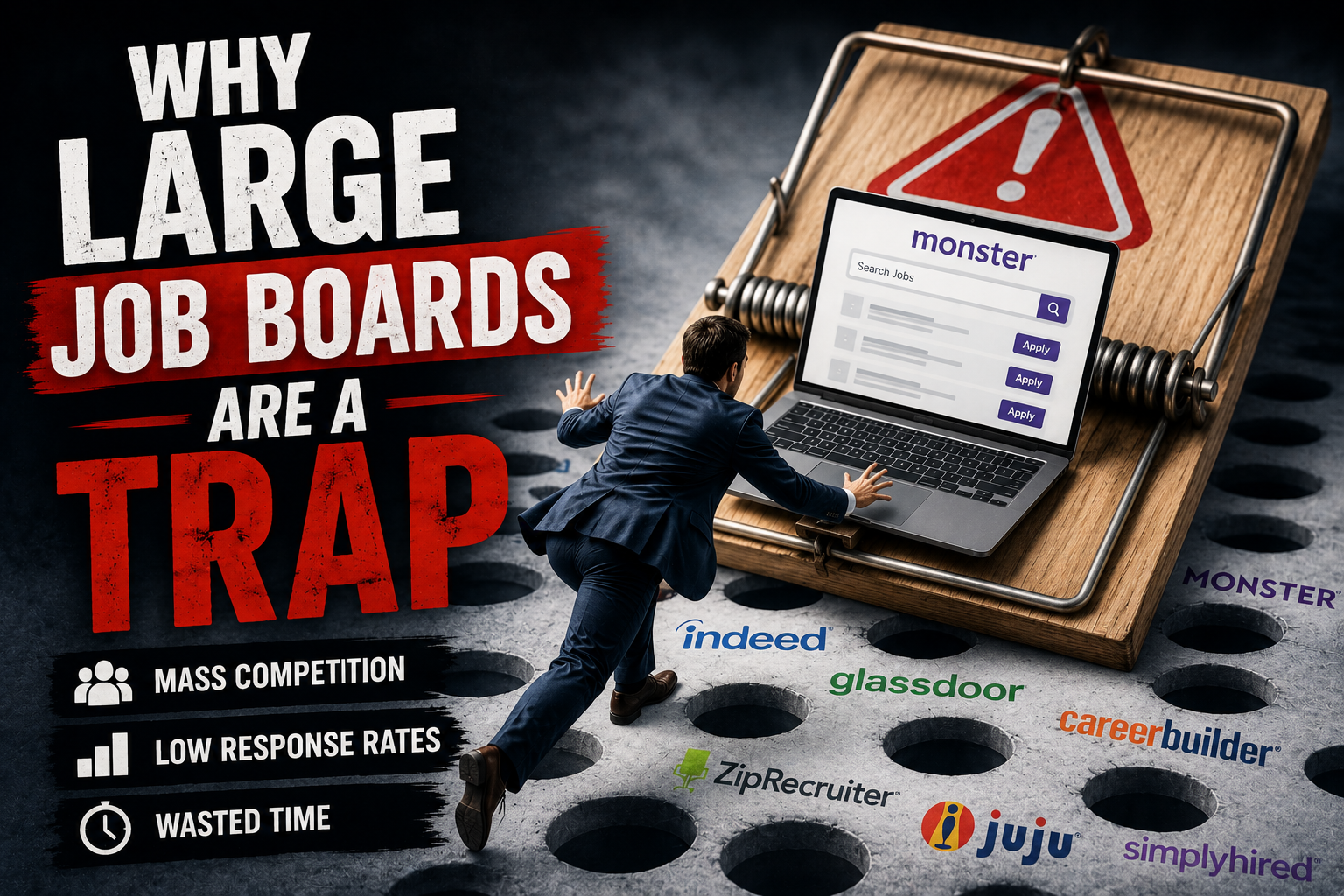
The following post explores Why Large Job Boards Are a Trap.
In the digital age, large job boards like Indeed, LinkedIn, Monster, and Glassdoor have become the default starting point for millions of job seekers.
Read: Staying Top of Mind After the Interview (With PDF Tip Sheet)
Related: How to Build a Target Employer List
When applying to postings on these sites is your main (or only) strategy, you’re unintentionally narrowing your options and potentially setting yourself up for failure.
Here’s what you need to know.
Overview
Too many job seekers are overly reliant on large job boards. It’s understandable why so many people use large job boards. Life is busy. Finding good jobs is hard. Using large job boards is a convenient and user friendly experience.
However, when something is too good to be true, it usually is.
The problem is that using large job boards is the easiest thing possible. They’re the path of least resistance. Unfortunately, as with most things in life, nothing worth having comes easy. Don’t get me wrong, large job boards can be helpful. Especially if you’re diligent and fast to apply to new postings. However, if this is your main (or only) strategy, it’s a problem.
Large Job Boards are Crowded
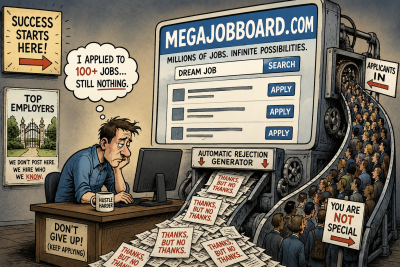
One of the core issues with large job boards is the sheer volume of applicants.
When you search for jobs on Indeed, millions of other job seekers are doing exactly the same thing. With so many users, it’s quite common to have hundreds of applicants in a matter of days.
Even if you’re disciplined about checking alerts, customizing your Resume, and being fast to act, you’re still just one application in a massive stack. Recruiters simply can’t give every submission the attention it deserves, due to the sheer volume of applicants on large job boards.
The reality is you’re facing a large pool of competition on these sites, which reduces your odds. Here is a link to an interesting Reddit forum discussion talking about large job boards.
Large Job Boards Have Questionable Jobs
The jobs you’re seeing on large job boards might not be the best quality. In fact, in some cases, the postings might be outright spam jobs.
Some postings are duplicated across multiple platforms, left online long after the position has been filled, or posted simply to collect Resumes and applicant data. Others may exist primarily to build a recruiting pipeline for future openings that may never materialize.
There are also situations where companies post roles publicly even though they already have an internal candidate in mind. In other cases, the compensation is misleading, the requirements are unrealistic, or the position itself is far less attractive than it initially appears.
The end result is that job seekers can spend hours applying to opportunities that were never realistic to begin with.
Large Job Boards Make You Feel Insignificant
Another issue with large job boards is the psychological effect they can have on job seekers.
When you spend hours submitting applications and rarely hear anything back, it’s easy to start questioning your value. You may feel like just another number in an endless stream of applicants.
Large job boards remove the human element from the process. Most applications are submitted through automated systems that filter, rank, and sort candidates before a real person ever reviews the Resume. In many cases, applicants never receive a response at all.
Large Job Boards Encourage Passive Behavior
One of the biggest dangers of large job boards is that they can encourage a passive approach.
For many job seekers, the routine becomes simple: log in, scroll through listings, click “apply,” and repeat. While this may feel productive, it often creates a false illusion of progress.
Instead of building connections, researching companies, identifying target employers, or networking strategically, many people spend the majority of their time scrolling for new postings.
The convenience of large job boards can unintentionally keep people stuck in low-impact activities rather than pursuing proactive strategies that may generate stronger opportunities.
In Conclusion
In conclusion, I hope this article helps you see why large job boards are a trap. While convenient and user friendly, large job boards are flawed. It’s okay to use large job boards at times, but if you’re serious about your job search, you need to take a more diversified approach.
If you need help navigating the job search process, my team and I are here to support you. Please use the Contact Us to express interest in learning more about our services for jump starting your job search. We look forward to hearing from you!
About the Author: Doug Levin