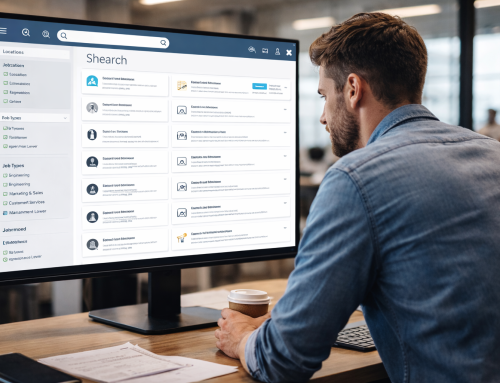

Understanding Your Resume’s Audience

The following post explores the topic of Understanding Your Resume’s Audience.
So, who is your Resume’s audience? This fundamental question must be considered when building your Resume. In most cases, there are two distinct audiences (a) the ATS (b) the human being.
Read: Considerations When Evaluating Multiple Job Offers
Related: How to Build a Target Employer List
If you’re applying to jobs on the internet, you must build a Resume that speaks to both audiences. The normal workflow is that your Resume is analyzed by ATS before reaching the human being.
Here’s what you need to know.
Overview
Building an ATS-friendly and visually appealing Resume should be your goal. However, all too commonly, job seekers build their Resume for one audience or the other.
For instance, selecting a Resume format that looks good to the human eye but is not ATS-friendly is a very common issue. The layout may look snazzy with columns, graphics, and tables but it won’t work well with ATS.
Alternatively, you may select an ATS-friendly format that allows you to load up the document with keywords – but the visual presentation falls flat with the human reader.
The fundamental challenge is building a document that satisfies both audiences.
Applicant Tracking System
In today’s modern hiring environment, most companies use an applicant tracking system for managing recruiting and hiring activities.
One of the things most ATS do is to automate the process of evaluating your Resume against the job announcement you’ve applied to. It’s looking to see how relevant your Resume is (based on keywords).
More broadly, you should understand that there are hundreds upon thousands of different ATS in Corporate America. ATS is an “umbrella term” for the software companies use to manage their job applications.
I ran a quick Google search and found a bunch of different ATS including…
Freshteam, ApplicantStack, Breezy HR, BrightMove, Bullhorn, IBM Watson Talent, Greenhouse Software, iCIMS Recruit, JazzHR, Jobsoid, Jobvite, Lever, Newton, Recruiterbox, SmartRecruit, The Applicant Manager, VIVAHR, Workday, and Zoho Recruit.
The ones listed above are just the tip of the iceberg. There are many, many more.
The point here is that it’s difficult to make generalizations about how ATS work because there are so many different ones and no two systems are coded quite the same.
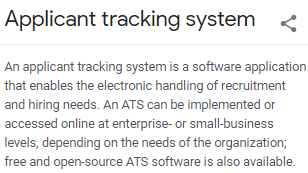
Pictured: screenshot of the definition of an Applicant Tracking System (ATS).
Human Being
After making its way past the ATS, your Resume is typically reviewed by a human being (such as the HR manager, recruiter, or hiring manager). This person is usually tasked with looking at lots of Resumes for lots of positions (not just the one you’re applying to).
Therefore, you need a visually appealing document that communicates a clear and concise message that resonates with human beings. More than simply making it eye-catching, your Resume must communicate a clear message that captures the interest and attention of the human being.
The thing about human beings is everything is subjective. For instance, some people prefer a one-page Resume, while others prefer a two-page Resume. Needless to say, human beings may be swayed by many different factors, whereas ATS is unemotional.
In Conclusion
In conclusion, I hope this article helps you understand the dual-nature of your Resume’s audience. In today’s modern job search, you need a visually appealing and ATS-friendly document that satisfies ATS and human beings alike.
If you’re ready for professional assistance with building your Resume, my team and I are here to support you. Please use the Contact Us or Submit Your Resume for a risk-free evaluation. JobStars is an A+ BBB-rated service that has earned multiple consecutive Complaint Free Awards.
We look forward to hearing from you!
About the Author: Doug Levin