
Understanding the DISES and DISL Promotion Process (for Federal Employees)
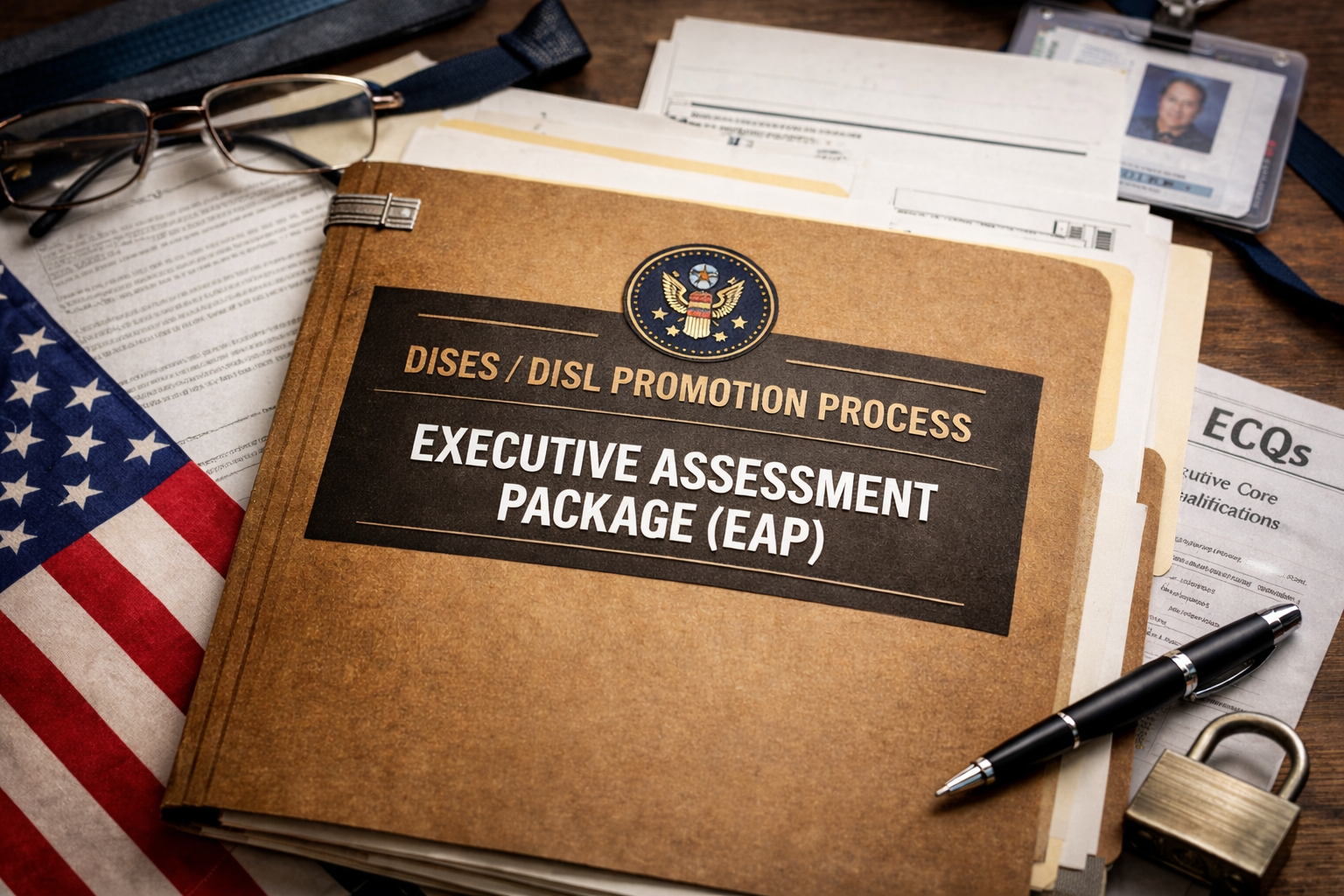
The following post explores Understanding the DISES and DISL Promotion Process (for Federal Employees).
If you are a senior-level federal intelligence professional pursuing executive advancement, DISES and DISL represent two of the highest civilian promotion tracks within the Defense Intelligence workforce.
Read: Best Federal Resume Writing Services
Related: Documents Needed for Applying to Federal Jobs
Advancement into these roles involves a structured promotion process designed to evaluate leadership performance, technical expertise, and enterprise-level mission impact.
Here’s what you need to know.
Overview of the DISES/DISL Promotion Process
What is the DISES / DISL promotion process?
The Defense Intelligence Senior Executive Service (DISES) and Defense Intelligence Senior Level (DISL) represent two of the highest civilian promotion tracks within the Defense Intelligence workforce.
In short, the DISES/DISL promotion process is a formal pathway for senior civilian professionals to advance into executive and senior technical leadership roles within the Defense Intelligence workforce.
DISES and DISL promotions involve a comprehensive review of a candidate’s leadership performance, technical expertise, and broader organizational impact. Candidates are evaluated through a structured assessment process that relies on documented accomplishments and leadership outcomes.
Pictured below is a screenshot of page #1 of the application instructions.
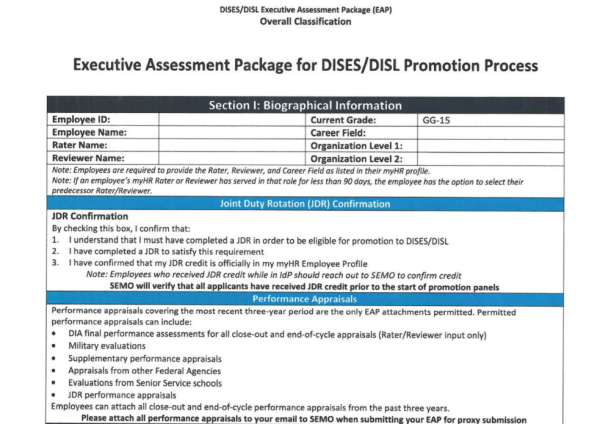
Executive Assessment Package (EAP)
If you are planning to apply for a DISES or DISL promotion, you will need to submit an Executive Assessment Package (EAP).
What is the EAP? It’s a collection of application materials including a two-page Federal Resume, Executive Core Qualifications (ECQs), Technical Qualifications (TQs), Intelligence Community Senior Core Qualifications (ICSOCQs), and more (in certain cases).
To qualify for a promotion, you will need to submit application materials according to the EAP instructions. Preparing a complete and well-organized package is critical. Submitting a thorough EAP does not guarantee promotion, but it is the required first step for consideration.
Two-Page Federal Resume
DISES and DISL candidates are typically required to submit a concise, two-page Federal Resume summarizing leadership experience, mission impact, and enterprise contributions.
Your two-page Federal Resume should highlight senior leadership responsibilities, cross-organizational initiatives, and measurable results demonstrating your readiness for executive-level roles.
Due to its strict length limitation, the two-page Federal Resume requires careful selection and prioritization of accomplishments. If you have a long and impressive career, two pages isn’t much to work with. This is one reason why Federal Job Seekers need a strong LinkedIn profile.
Executive Core Qualifications (ECQs)
Preparing your Executive Core Qualifications (ECQs) is one of the most challenging aspects of the EAP.
ECQs are narrative statements, typically around 3,600 characters each, that describe your executive leadership experience and accomplishments. They are used by review boards to evaluate your ability to lead at a senior level, demonstrate strategic impact, and manage complex organizational challenges.
Earning DISES/DISL promotion is a highly competitive undertaking. ECQs are used to weed out certain applicants. If you don’t want to be weeded out, you need strong ECQs. That’s where hiring a professional service to write your ECQs is a worthwhile investment.
If you’re attempting to write your ECQ statements, I implore you not to underestimate this aspect of the process. It takes a combination of strategy, planning, and effort.
If you’ve never done ECQs, I recommend exploring these articles: Understanding the New ECQs, Tips for Selecting Your ECQ Stories, and How to Write ECQs Using CCAR.
Technical Qualifications (TQs)
The Technical Qualifications (TQs) is a written statement, usually with a maximum length of 3,690 characters. TQs document a specific example of a candidate’s subject matter expertise and ability to apply specialized knowledge to complex mission challenges.
TQs are typically required for DISL candidates and for DISES candidates whose roles have a significant technical or operational component.
In some cases, TQs may not apply, particularly for purely managerial or executive leadership positions. Agencies may instead request other qualification narratives or rely primarily on ECQs and ICSOCQs to evaluate leadership and mission impact.
Intelligence Community Senior Core Qualifications (ICSOCQs)
The ICSOCQs is a written statement, usually with a maximum length of 3,690 characters, that documents a specific example of a candidate’s leadership ability within the Intelligence Community.
ICSOCQs demonstrate a candidate’s effectiveness in interagency collaboration, integration of intelligence capabilities across organizations, support of national security objectives, and management of complex, mission-driven environments. They ensure that candidates show leadership readiness not only within their home agency but across the broader Intelligence Community.
Wondering about the difference between ICSOCQs, ECQs, and TQs? It’s focus.
ECQs emphasize executive leadership competencies across any federal context. TQs document technical or mission-specific expertise. ICSOCQs specifically assess a candidate’s ability to lead and deliver results in an interagency, Intelligence Community environment.
Joint Duty Rotation Credit (JDR) Credit
The Joint Duty Rotation (JDR) Credit is a written statement, usually with a maximum length of 3,690 characters, that documents a candidate’s experience in qualifying joint duty assignments.
It demonstrates the candidate’s ability to work across agencies or mission areas and contribute to enterprise-level Intelligence Community objectives.
For candidates who have not completed a joint duty assignment, agencies may allow alternative documentation or focus evaluation on other EAP components such as ECQs, TQs, or ICSOCQs.
In Conclusion
In conclusion, I hope this article helps you with understanding the DISES and DISL promotion process. It represents a rigorous evaluation of senior leadership readiness within the Defense Intelligence workforce. Understanding the EAP structure and its required components can help qualified federal employees prepare strategically for advancement opportunities within DCIPS organizations.
If you’re ready for professional assistance with building your new two-page Federal Resume, my team and I are here to support you. Please use the Contact Us or Submit Your Resume for a risk-free evaluation. JobStars is an A+ BBB-rated service that has earned multiple consecutive Complaint Free Awards.
Download the DISES/DISL EAP Worksheet (PDF)
About the Author: Doug Levin