
Tips for Selecting Your ECQ Stories

The following post explores Tips for Selecting Your ECQ Stories.
Are you applying to Senior Executive Service (SES) roles within the U.S. federal government? If so, you’ll need Executive Core Qualification (ECQ) stories that demonstrate your leadership acumen.
Read: How to Write ECQs Using CCAR
Related: Best Federal Resume Writing Services
First things first – you need to reflect on your experience and identify specific examples from your work history that illustrate the ECQ competencies being assessed.
Here’s what you need to know.
Overview
In 2025, the ECQs process changed drastically under the federal government’s Merit Hiring Plan. Most notably, applicants are no longer required to submit the traditional 10-page ECQs.
Once a hallmark of the old system, applicants were expected to craft five separate essays, each running nearly two pages, with carefully structured examples aligned to the CCAR format.
While this approach did allow for deep storytelling, it also created a barrier for otherwise qualified candidates who struggled to translate executive leadership into dense narrative form.
Old ECQs (Ending in 2025)
- ECQ 1: Leading Change
- ECQ 2: Leading People
- ECQ 3: Results Driven
- ECQ 4: Business Acumen
- ECQ 5: Building Coalitions
New ECQs (Starting in 2025)
Under the ‘Merit Hiring Plan’, the ECQs have been updated for the first time since 2006.
The number of ECQs remains five, but the definitions and behavioral indicators have been refreshed. These are the five new ECQs announced in May 2025.
- ECQ 1: Commitment to the Rule of Law and the Principles of the American Founding
- ECQ 2: Driving Efficiency
- ECQ 3: Merit and Competence
- ECQ 4: Leading People
- ECQ 5: Achieving Results

Methods for Communicating ECQs
Historically, ECQs were evaluated through standalone narrative essays. Applicants typically prepared one essay for each of the five ECQs, with narratives often running up to two pages per qualification for a total submission of approximately ten pages.
Under the new Merit Hiring Plan, agencies have greater flexibility in how they assess ECQs. Depending on the position and agency, your leadership qualifications may be evaluated through one of three methods:
- (a) Structured Interview: Verbally articulate your ECQ stories in response to targeted leadership questions during a formal interview setting.
- (b) One-Page Narrative Statements: Submit one-page narrative statements for each of the five ECQs (totaling five pages).
- (c) Integrated in the Federal Resume: Submit a two-page Federal Resume that weaves the five ECQs directly into your work history.
Study Each ECQ
Before selecting your ECQ stories, it’s important to understand what each ECQ is actually measuring.
Each ECQ represents a broad executive leadership qualification, but each one is also made up of several sub-competencies. These sub-competencies define the specific skills, behaviors, and leadership attributes agencies are looking for in SES candidates.
For example, Driving Efficiency is not simply about managing resources effectively. It also encompasses three distinct sub-competencies: Fiscal Responsibility, Managing Resources, and Leveraging Technology. Together, these elements define what success in that ECQ looks like.
As you review your career accomplishments, compare them against both the ECQ and its sub-competencies. The strongest examples are those that demonstrate multiple aspects of the qualification rather than just a single element.
This is why studying the ECQs before selecting your stories is so important. A compelling leadership accomplishment may not be the right choice if it fails to demonstrate the competencies the ECQ is intended to measure.
Select Your Stories
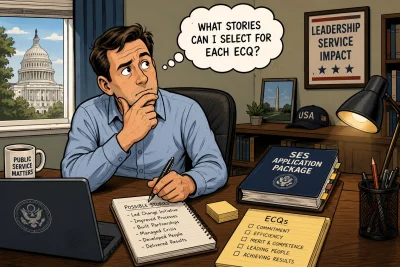
Now that you understand the ECQs and reflected on your experience, it’s time to select one strong, distinct example for each ECQ.
Think in terms of CCAR: does the story include a meaningful challenge, a clear context, decisive actions you took, and measurable results? Your examples should be varied enough to show the full range of your leadership capabilities across different settings and responsibilities.
This step is where strategy meets storytelling. Avoid reusing the same scenario across multiple ECQs, and avoid examples that lean too heavily on technical expertise without demonstrating executive leadership.
Outline Your Stories
If a story doesn’t address enough of the leadership behaviors required, it’s better to find that out before you start writing. That’s why I recommend outlining your ECQs.
Start by selecting one story per ECQ – ideally, one that showcases breadth and depth of executive leadership. Then, map each story using the CCAR model (Challenge, Context, Action, Result).
As you outline the story, be intentional. Your outline should explicitly connect parts of your story to the ECQ’s subcomponents so nothing critical gets overlooked.
Hiring a Federal Resume Writer
Preparing ECQs can be one of the most challenging aspects of the SES application process. Candidates must not only identify strong leadership examples but also ensure those examples align with the ECQs and their underlying competencies.
Hiring an experienced Federal Resume Writer can simplify the process. They understand what agencies are looking for, can identify the strongest stories from your career, and can help present your accomplishments in a way that effectively demonstrates executive leadership.
Perhaps most importantly, professional assistance provides peace of mind. Rather than wondering whether you’ve selected the right examples or addressed the right competencies, you can move forward with greater confidence knowing your ECQs have been developed using a proven approach.
In Conclusion
In conclusion, I hope this article offers helpful Tips for Selecting Your ECQ Stories. Before you can write ECQs, the subject matter you’re writing about must be defined. You need five unique stories (one for each of the five ECQs). Each story must tie back to one of the five ECQs (and its sub-competencies). Honestly, it’s a difficult task. Which makes sense because SES roles are highly sought after and competitive.
If you’re ready to build your new ECQs, my team and I are here to support you. Please use the Contact Us for a risk-free evaluation. JobStars is an A+ BBB-rated service that has earned multiple consecutive Complaint Free Awards. We look forward to hearing from you!
About the Author: Doug Levin