

Career Snapshot: Security Guards and Gambling Surveillance Officers
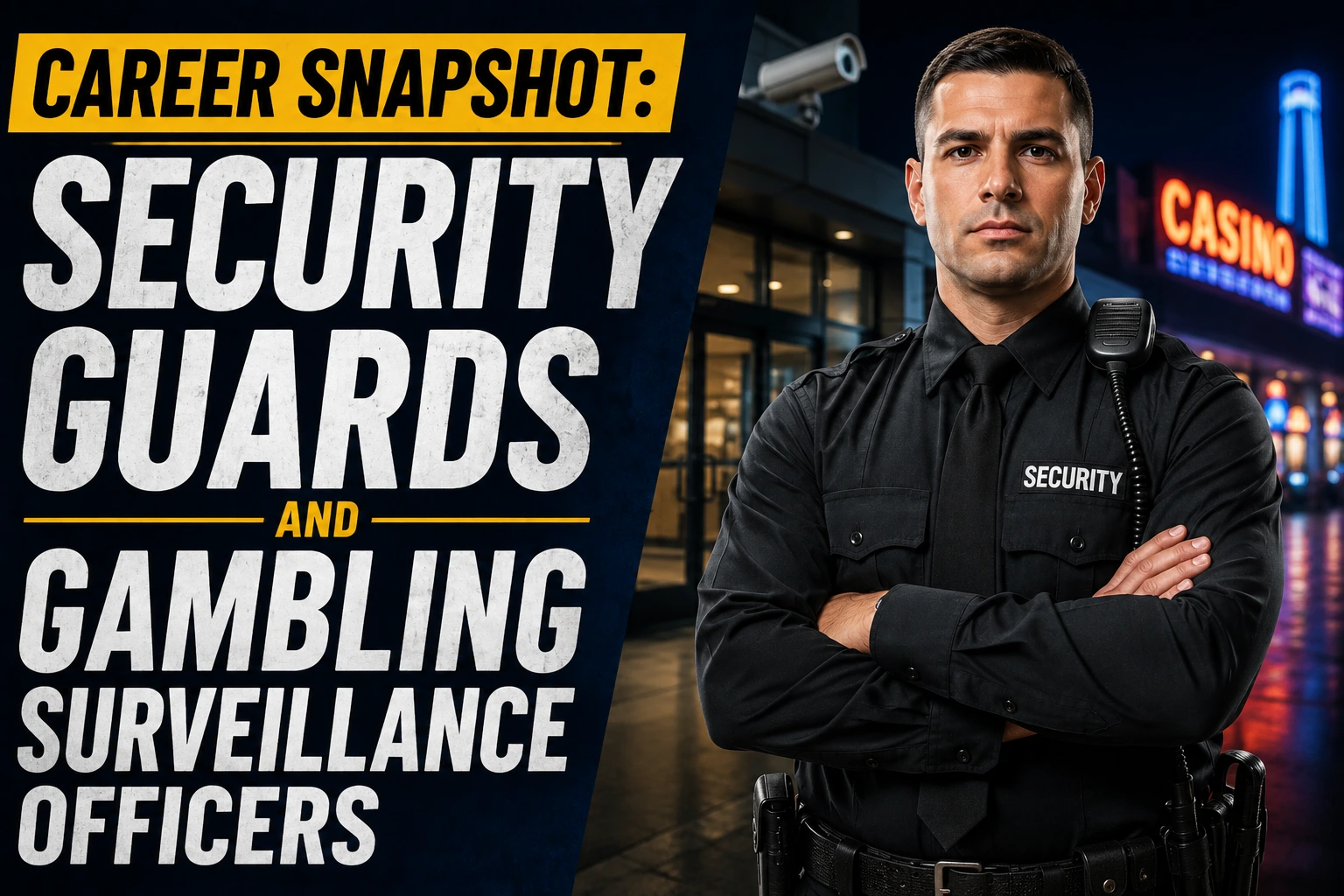
The following post features a Career Snapshot of Security Guards and Gambling Surveillance Officers.
Have you ever considered a career as a security guard or gambling surveillance officer but found yourself wondering what the job is really like?
Read: How to Handle Getting Ghosted After an Interview
Related: Why You Should Contact the Hiring Manager After Applying
While many people assume the work is simply about standing watch, the reality is often much more dynamic and varied depending on the employer and work environment.
Here’s what you need to know.
Overview
Security guards and gambling surveillance officers have one thing in common: they’re trusted to protect people, property, and assets. How they accomplish that, however, depends entirely on the assignment.
A security guard working at a hospital might spend the day helping visitors, responding to emergencies, and calming tense situations. Someone assigned to a manufacturing plant may focus on checking delivery trucks and monitoring restricted areas. In a casino, surveillance officers watch gaming activity through sophisticated camera systems, looking for signs of cheating, theft, or other suspicious behavior.
That’s one reason it’s difficult to describe a “typical” day in security. The industry is broad, and employers have very different expectations. If you’re considering this career, pay as much attention to the employer and work environment as you do the job title.
What They Do
The best security professionals often go unnoticed.
When everything is running smoothly, most people never stop to think about who’s monitoring the building, checking entrances, responding to alarms, or watching surveillance cameras. That’s exactly how employers like it. Good security is often measured by the problems that never happen.
Depending on the position, you might patrol a property, verify employee badges, monitor CCTV systems, write incident reports, or coordinate with police and emergency responders when needed. Gambling surveillance officers typically work from observation rooms, using audio and video equipment to detect cheating, theft, and other violations inside casinos.
If you’re expecting constant action, you may be surprised. Much of the job involves paying attention, following procedures, and recognizing when something doesn’t look quite right. Patience is just as important as quick decision-making.
Work Environment
Few occupations offer as much variety as security.
You could spend your shift walking through a distribution center, helping visitors at a corporate headquarters, working security at a sporting event, or monitoring surveillance equipment in a casino. Every assignment has its own pace, challenges, and expectations.
That variety is one of the profession’s biggest strengths. If you discover that retail security isn’t the right fit, you don’t necessarily have to leave the field. Healthcare, education, manufacturing, hospitality, transportation, and government agencies all employ security professionals.
One thing that doesn’t change is the schedule. Because many facilities operate around the clock, nights, weekends, and holidays are common. For some people that’s a deal-breaker. For others, it’s exactly what makes the career appealing.
Education & Training
Getting started doesn’t usually require years of education. Most employers look for candidates with a high school diploma or equivalent and provide job-specific training after hiring. That training often covers emergency procedures, report writing, communication, and company policies.
Most states require security guards to be licensed, and armed positions typically have additional requirements. If you’re interested in casino surveillance, previous experience with security or video monitoring can be an advantage, although employers often provide specialized training as well.
This is one of those professions where reliability and professionalism can take you just as far as formal education. A strong work ethic and a willingness to learn often open the door to more specialized roles over time.
Salary Expectations
Security work can provide a steady income without requiring a four-year degree, although pay varies by employer, location, and assignment.
According to the U.S. Bureau of Labor Statistics, the median annual wage for security guards was $38,370 in 2024, while gambling surveillance officers and investigators earned $43,900. Positions in government, healthcare, education, and specialized security assignments may offer higher wages than entry-level contract security jobs.
If you’re comparing opportunities, don’t focus on salary alone. Benefits, overtime opportunities, work schedules, and advancement potential can have just as much impact on your long-term satisfaction.
Career Outlook
The demand for security professionals isn’t expected to grow rapidly over the next decade, but that doesn’t mean opportunities are disappearing. Employers are projected to hire roughly 162,300 security guards and gambling surveillance officers each year, largely to replace workers who retire or move into other occupations.
Technology is changing the field, especially as surveillance systems become more sophisticated. Even so, cameras can’t interview a witness, calm an upset customer, or decide how to respond when a situation unfolds unexpectedly. Employers still need people who can think clearly and exercise good judgment.
Resume Considerations
Security resumes often look too much alike. Many applicants simply list duties like patrolled property or monitored cameras. Hiring managers already know those are part of the job. What they really want to know is how well you performed those responsibilities.
Think about the scope of your work. Did you monitor a single office building or a campus with multiple facilities? Were you responsible for one entrance or dozens of surveillance cameras? Have you responded to medical emergencies, completed detailed incident reports, or helped de-escalate confrontations? Those are the details that make a resume stronger.
Finally, pay attention to the language employers use in their job postings. Keywords such as access control, CCTV monitoring, incident reporting, emergency response, patrol operations, de-escalation, visitor management, surveillance systems, and loss prevention appear frequently.
In Conclusion
In conclusion, I hope you find this post helpful for understanding Security Guards and Gambling Surveillance Officers. If you’re looking for a career that offers a relatively quick entry point, meaningful responsibility, and opportunities across many industries, security is worth exploring.
If you’re ready for professional assistance with building your ATS-friendly and visually appealing Resume, my team and I are here to support you. Please visit Resume Writing or Submit Your Resume for a risk-free evaluation. We look forward to hearing from you!
About the Author: Doug Levin