

Understanding GS Level in Federal Jobs

The following post explores the topic of Understanding GS Levels in Federal Jobs.
New to USAJOBS? If so, one of the first things you’ll notice is that federal job announcements often reference GS levels. If you’re coming from the private sector, these classifications may seem confusing.
Read: What You Need to Know When Applying to Federal Jobs
Related: Best Federal Resume Writing Services
Understanding how the General Schedule works can help you make better decisions about which federal jobs to target. This guide provides a foundational overview of GS levels, pay structure, and estimating your level.
Here’s what you need to know.
What Is the General Schedule (GS)?
The General Schedule (GS) is the pay classification system used by most federal civilian agencies to organize positions by responsibility level and compensation. It creates a standardized framework for hiring, advancement, and salary administration across government roles.
The GS system includes 15 grades, ranging from GS-1 through GS-15, with each grade containing 10 salary steps. In general, higher grades reflect more advanced duties, greater independence, and increased expectations for experience or specialized expertise.
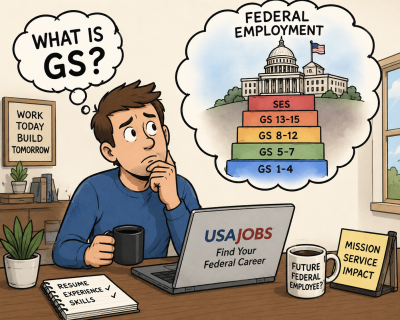
How Federal GS Pay Works
Your GS grade reflects the overall level of the position, while your step determines your salary progression within that grade. For example, a GS-11 Step 1 earns less than a GS-11 Step 10, even though both employees hold positions at the same grade level.
Federal salaries also include locality pay adjustments, which account for regional labor market differences and cost considerations. This means a GS-12 position in Washington, DC, may pay significantly more than the same GS-12 role in another part of the country.
👉 Understanding Federal Pay
GS 1–7: Entry-Level and Administrative Roles
Positions in the GS 1–7 range generally include entry-level, support, clerical, and early-career professional roles. Common examples include assistants, technicians, administrative staff, and some recent graduate positions.
Applicants may qualify for these roles through education, relevant experience, or a combination of both, depending on the specific position. For many job seekers, this range serves as the starting point for building a long-term federal career.
GS 8–12: Professional and Mid-Level Roles
The GS 8–12 range typically includes professional, technical, and specialized roles that require more independent judgment and subject matter expertise. Common examples include analysts, specialists, investigators, contract professionals, and technical staff.
Qualification requirements at this level often focus heavily on specialized experience directly related to the job. Many federal career ladder positions also fall within this range, allowing employees to progress from one grade to the next based on performance and eligibility.
GS 13–15: Senior-Level and Leadership Roles
Positions in the GS 13–15 range generally involve senior-level expertise, leadership responsibilities, or oversight of complex programs and operations. These roles may include senior analysts, supervisors, program managers, division leaders, and high-level technical experts.
Candidates at this level are typically expected to demonstrate substantial specialized experience and a track record of handling increasingly complex responsibilities. Advancement into these grades is driven more by depth of experience and scope of impact than by academic credentials alone.
Senior Executive Service (SES)
The Senior Executive Service (SES) sits above the General Schedule and represents the highest level of federal civilian leadership. These positions are reserved for executives responsible for directing major agency functions, shaping policy, and leading large organizations.
SES roles often require exceptional leadership experience, strategic decision-making ability, and a history of managing enterprise-level initiatives. These positions are far less common than traditional GS roles and follow a distinct hiring and compensation structure.
👉 Relevant Posts for SES Candidates
- How to Write ECQs Using CCAR
- Tips for Selecting Your ECQ Stories
- Understanding Executive Schedule Pay vs. SES Pay (for Federal Job Seekers)
- Understanding SES Sabbatical Eligibility (for Federal Employees)
- Understanding the Difference Between SES, ST, and SL (for Federal Job Seekers)
- Understanding the New ECQs
- Understanding the SES Candidate Development Program (SESCDP)
- Understanding the SES Qualifications Review Board (for Federal Job Seekers)
- Why Your ECQs Didn’t Pass QRB and How to Fix Them
How to Estimate Your GS Level
If you are already a federal employee, your current grade may provide a useful reference point when evaluating new opportunities. If you are transitioning from the private sector, there is usually no exact one-to-one conversion between your current job title and a federal GS level.
Instead, review the qualifications section of federal job announcements carefully, paying close attention to specialized experience requirements and the scope of work described. Matching your experience to the duties listed in the announcement is often the most practical way to estimate the grades you may be qualified to pursue.
In Conclusion
In conclusion, I hope you find this helpful for understanding GS level in federal jobs. With a clearer understanding of GS levels, you can more effectively navigate the application process and identify opportunities that align with your background.
If you’re ready for professional assistance with building your new two-page Federal Resume, my team and I are here to support you. Please use the Contact Us or Submit Your Resume for a risk-free evaluation. JobStars is an A+ BBB-rated service that has earned multiple consecutive Complaint Free Awards.
About the Author: Doug Levin