
Staying Top of Mind After the Interview (With PDF Tip Sheet)

The following post explores Staying Top of Mind After the Interview (With PDF Tip Sheet).
Many job seekers treat the interview as the finish line. Once the “thank yous” are exchanged, we tend to replay our best answers in our heads, and then settle into a passive state of waiting.
Read: Spotting Company Culture When Interviewing
Related: Understanding AI Scored Interviews
But from an employer’s perspective, the interview is not the end of the process, it’s the “Decision Window” period, and your ability to stay top of mind during this time can make a big difference.
Here’s what you need to know.
The Psychology of the Decision Window
The moment you leave the room (or after the Zoom call ends), a psychological phenomenon known as the “Recency Effect” begins to work against you. This principle suggests that people remember the most recent information they receive most clearly, but as time passes, those details begin to blur.
If you disappear into total silence after an interview, you are leaving a valuable follow-up opportunity on the table. You are allowing the hiring team’s memory of you to be dictated by the energy of the next candidate they meet rather than your own performance.
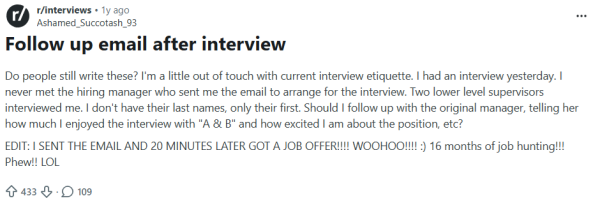
Staying top of mind is about anchoring your best qualities in their memory before that fade begins. Below is a screenshot from a Reddit forum discussion about following up after an interview.
Providing Ammunition for Your Internal Advocate
Hiring is rarely a solo decision; it is a consensus-building exercise.
Your primary interviewer now has to become your internal advocate, selling your fit to skeptics on the team or to a busy executive who wasn’t in the room. When you provide thoughtful, strategic follow-up, you aren’t just being polite—you are providing your advocate with the ammo they need to defend your candidacy.
This is your opportunity to clarify points of concern raised during the meeting and reinforce why you are the low-risk, high-reward choice for the role.
Reclaiming Your Agency and Perspective
While much of the post-interview phase feels like you are under a microscope, it is important to remember that this is also your primary window for objective reflection.
In the heat of an interview, adrenaline can mask red flags or cause you to gloss over inconsistencies in how different team members described the role. The period immediately following the conversation is the only time you can accurately “interview the employer” in retrospect.
Successful candidates use this time to deconstruct the experience, asking themselves if the team’s energy felt sustainable and if the challenges described align with their own career goals.
Avoiding the Friction of Silent Mistakes
Post-interview mistakes are rarely dramatic; they are usually quiet lapses in judgment that create friction.
One common pitfall is the “Strategy Stall,” where a candidate finds an interview they feel great about and immediately pauses the rest of their job search. This is a mistake of leverage. By stopping your momentum elsewhere, you inadvertently signal a sense of waiting that can weaken your negotiating position later.
Furthermore, the high-adrenaline nature of an interview means that within 24 hours, you will likely forget 50% of the nuanced details discussed (details that could have been the key to winning a second round).
Why Structure Trumps Instinct
Relying on instinct during the post-interview phase is a gamble because your brain is naturally wired to seek relief after a stressful event. Good intentions often get delayed by the “day job” or general life fatigue, leading to inconsistent follow-ups and missed opportunities.
The most successful candidates don’t wing it; they follow a structured protocol that keeps them proactive while the hiring team is making their choice. Structure makes it easier to stay in control and maintain a professional presence when your energy is low.
In Conclusion
In conclusion, I hope you find this article helpful for staying top of mind after the interview. Without a plan, the days following an interview can feel like a blur of second-guessing and checking your email. To help you stay top of mind, I have developed a PDF worksheet that offers a tactical, reusable framework designed to be used the moment an interview ends. I hope you find it helpful!
If you’re ready for professional help to build your ATS-friendly and visually appealing Resume, please fill out the Contact Us form or Submit Your Resume for a risk-free evaluation. JobStars is an A+ BBB-rated service that has earned multiple consecutive Complaint Free Awards. We look forward to hearing from you!
Download: What To Do After the Job Interview (PDF)
About the Author: Doug Levin