
How to Use Recruiters to Find a Job

The following post explores How to Use Recruiters To Find a Job.
Job searching is a time-consuming and potentially frustrating process. If you’re like most job seekers, you’ve spent hours scrolling through job boards, tailoring your resume, and submitting applications.
Read: Understanding the Hidden Job Market
Related: Mapping Your Professional Network (with PDF Worksheet)
While applying to job postings is necessary, it’s not your only option. To maximize your chances of finding the right opportunity, it’s important to expand your approach beyond online applications.
Here’s what you need to know.
Overview
Connecting with recruiters is a great strategy for jump starting your job search. Recruiters are the middleman between hiring managers and job seekers. Their job is to fill roles with qualified candidates.
Connecting with recruiters means proactively reaching out to introduce yourself and position yourself as a candidate worthy of their time, attention, and consideration for job opportunities they’re trying to fill.
However, before you start reaching out, it’s important to understand how recruiters work. Not all recruiters operate the same. Some work directly for a company, while others are independent or agency-based.
Types of Recruiters
Whether you’re seeking a permanent role, a temporary position, or an executive-level opportunity, knowing how each type of recruiter operates allows you to navigate the hiring process more effectively.
At the risk of oversimplifying, here is a run-down of the different types of recruiters in the business world.
- In-House Recruiters – internal employees responsible for filling job openings within their organization.
- Contingency Recruiters – third-party recruiters who are only paid if they successfully place a candidate.
- Retained Recruiters – third-party recruiters who are paid upfront to fill high-level or specialized roles.
- Executive Recruiters – third-party recruiters (contingency or retained) who focus on senior-level talent.
- Staffing Agency Recruiters – third-party recruiters who focus on temp, contract, or temp-to-hire roles.
Recruiters Don’t Work For You
One of the biggest mistakes job seekers make when attempting to connect with recruiters is assuming that the recruiter is going to actively search for a job on their behalf.
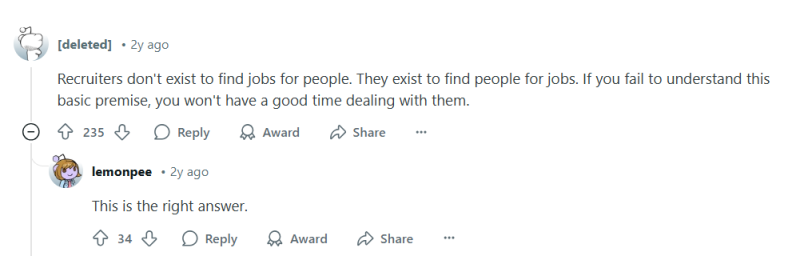
Recruiters don’t work for job seekers. They work for the companies that hire them to fill specific roles. Their focus is on finding candidates who match their client’s needs, not on helping individuals get hired.
If a recruiter doesn’t see you as a strong fit for a position they’re working on, they won’t prioritize you. That’s why it’s essential to present yourself as a placement-worthy candidate. The more aligned you are with the positions they’re trying to fill, the more likely they are to take an interest in you.
Below is an excerpt from a reddit discussion about the role of recruiters.
Think Long Term
When connecting with recruiters, it’s crucial to adopt a long-term mindset. It’s easy to expect immediate results after reaching out to a handful of recruiters, but job searching is often a gradual process.
Think of your efforts as planting seeds – each connection you make may not bear fruit right away, but over time, these relationships can grow into valuable opportunities.
Recruiters may not always have the perfect role for you at the moment, but by positioning yourself as a thoughtful, strategic candidate, you stay on their radar for future positions.
Don’t rush the process or appear desperate; instead, focus on cultivating meaningful connections and positioning yourself as a placement worthy candidate for future opportunities.
Identify Specific Firms
One strategy for connecting with recruiters is identifying specific third party agencies and visiting their website. Most firms have a “Contact Us” or “Submit Your Resume” section on their website.
The majority of recruiting firms want to hear from qualified candidates. It expands their talent pool and ensures they have a diverse range of talent to draw from when attempting to fill positions.
To help you find specific firms to contact, I’ve put together a List of Employment Agencies (by Industry), a List of Local Employment Agencies (by City), and a List of Executive Search Firms.
Find Recruiters on LinkedIn
Another strategy for connecting with recruiters is by identifying and engaging with them on LinkedIn, which is one of the most popular platforms recruiters use to source and vet candidates.
Given LinkedIn’s vast professional network, most recruiters use it extensively to find and connect with top talent. By being active on the platform, you can increase your chances of getting noticed.
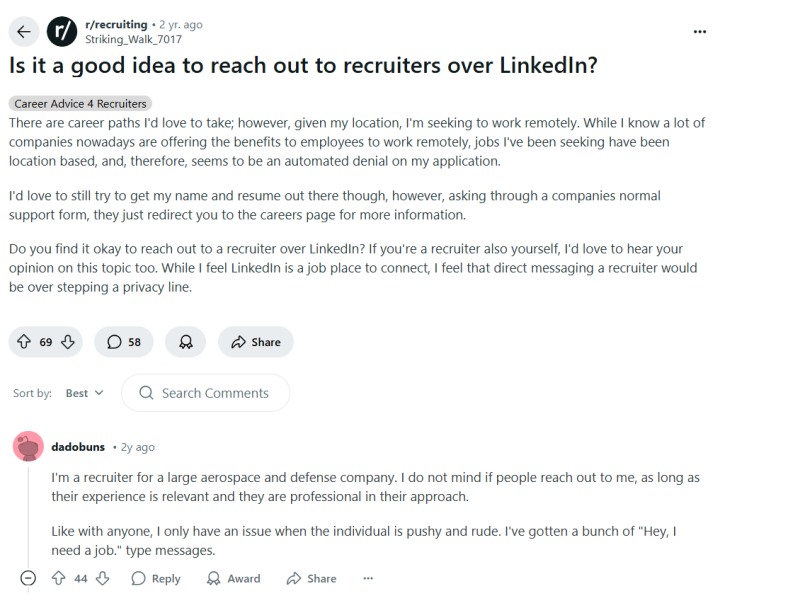
While it may be tempting to send a direct message on LinkedIn, keep in mind that recruiters’ inboxes are often flooded with messages. You run the risk of getting overlooked or simply ignored.
Taking a strategic and subtle approach is a more effective way to get notices. For instance, you could ‘follow’ their profile and engage organically, such as commenting or sharing their posts.
Below is an excerpt from a reddit discussion about reaching out to recruiters on LinkedIn.
Use a Resume Distribution Service
If you’re pressed for time or looking for a more convenient option, a Resume Distribution service is a great option to broaden your reach and get your resume in front of multiple recruiters at once.
Looking for a simple and convenient way to send your resume to loads of recruiters? Resume Distribution is our signature service for emailing your resume to 500 to 2,000+ recipients.
Getting your resume into recruiters’ hands is a great way to tap into jobs that are not publicly advertised.
Other Strategies
In addition to the aforementioned strategies for connecting with recruiters, here are a few more options to consider.
- Events and Job Fairs – Attend industry conferences, career expos, and meetups where recruiters are.
- Industry Associations – Join professional organizations in your industry and attend hiring events.
- Employee Referrals – Ask colleagues if they can introduce you to recruiters they’ve worked with.
- Alumni Networks – Leverage your university’s alumni network to find recruiters in your industry.
- Webinars and Online Events – Participate in online events where recruiters are likely to attend.
In Conclusion
In conclusion, I hope this article helps you understand how to use recruiters to get a job. While there isn’t a set playbook for success, you need to be thoughtful and strategic in your approach.
If you’re ready for professional help building your ATS-friendly and visually appealing Resume, please fill out the Contact Us form or Submit Your Resume for a risk-free evaluation. JobStars is an A+ BBB-rated service with multiple consecutive Complaint Free Awards. We look forward to hearing from you!
About the Author: Doug Levin