
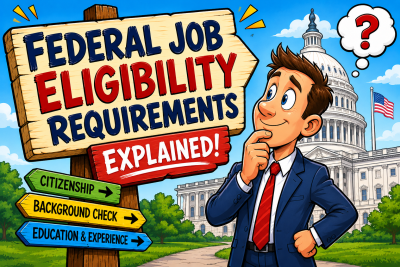
Federal Job Eligibility Requirements Explained

The following post explores Federal Job Eligibility Requirements Explained.
Are you interested in applying to jobs with the U.S. federal government? The federal hiring process can feel complicated at first, especially if you’re coming from the private sector.
Read: Options for Creating a Federal Resume
Related: Best Federal Resume Writing Services
While not every requirement applies to every position, there are some common rules of the road that most applicants should understand.
Here’s what you need to know.
Overview
This post offers a practical overview of common eligibility requirements so you know what to expect before investing time in the application process.
Eligibility requirements for federal employment may vary from job to job. For example, national security or law enforcement jobs may require a background check, drug test, and/or security clearance. Whereas jobs requiring specialized skills or knowledge may require certifications, licenses, or experience in a specific field.
Now that you understand what eligibility requirements are – here are some of the most important requirements to consider when applying for a job with the U.S. federal government.
U.S. Citizenship
In most cases, federal employees must be U.S. citizens. If you’re exploring federal opportunities for the first time, this is one of the first requirements you’ll want to confirm.
While there are limited exceptions, most federal roles are reserved for U.S. citizens, especially ones involving national security, public trust, or access to sensitive systems. For the average applicant, it’s safest to assume citizenship will be required unless the posting says otherwise.
Minimum Age
Federal employees must generally be at least 18 years old. That said, some roles may have additional age-related requirements depending on the nature of the work.
This tends to come up more often in specialized occupations like law enforcement or other physically demanding roles. As always, the individual job announcement is where you’ll find the exact eligibility criteria.
Selective Service Registration
This is one of those federal requirements that can catch applicants off guard. Most male applicants born after December 31, 1959, must be registered with the Selective Service System or qualify for an exemption.
If this requirement applies to you and hasn’t been satisfied, it can create an eligibility issue during the hiring process. In some situations, applicants may need to provide documentation explaining an exemption or special circumstance.
Education and Experience Requirements
Many federal jobs have minimum qualification requirements tied to education, work experience, or a combination of both. This is where federal hiring can differ quite a bit from what private-sector applicants are used to seeing.
Some positions require specialized experience at a certain level, while others allow education to substitute for experience. Depending on the role, you may also need to submit transcripts, licenses, certifications, or other supporting documentation.
Background Investigation
Federal employees must undergo a comprehensive background investigation, which may include a review of criminal and credit history, prior employment, and other relevant factors.
Background investigations help to ensure that federal employees are trustworthy and can be relied upon to handle sensitive information and perform their duties with integrity.
Contrary to popular belief, having a criminal record does not automatically disqualify you from obtaining federal employment.
Suitability Review
Meeting the qualifications for a federal role doesn’t automatically mean you’ll be cleared for employment. Agencies may also evaluate broader suitability factors when deciding whether to move forward.
This can include issues like misconduct, falsifying application materials, prior federal employment concerns, or failure to meet certain legal obligations. Think of this as a general assessment of whether you’re considered appropriate for federal service.
Medical Examination
Some federal jobs may require a medical examination to ensure that employees are physically able to perform the duties of the role. This may include a review of medical history, a physical examination, and other relevant testing.
This is generally limited to positions where physical capability is directly connected to job performance. If you’re applying for a typical office-based federal role, this usually won’t be part of the process.
Security Clearance
Certain federal jobs may require a security clearance, which is a determination by the government that a person is eligible for access to classified information. The required clearance level will depend on the nature of the position.
This tends to apply to jobs involving defense, intelligence, national security, or access to protected government information. If a clearance is required, that expectation will typically be made clear in the posting.
Check out this post for an overview of Applying to Federal Jobs without a Security Clearance.
Drug Testing
Many federal jobs require drug testing as a condition of employment, and employees may also be subject to random drug testing during their employment. This helps to ensure that federal employees are drug-free and able to perform their duties effectively.
Not every federal role includes drug testing, but many do. If testing is required, you’ll usually see that disclosed directly in the job announcement.
Check out this post by SAMHSA for a helpful rundown of frequently asked questions pertaining to federal civilian employee drug testing.
Training and Certification
Federal employees may be required to complete training programs, both when they first start their job and throughout their careers, in order to maintain their skills and stay up-to-date on changes in their field.
Some positions also require you to show up with the right credentials already in hand. This is especially common in healthcare, legal, technical, and other licensed professions.
Financial Disclosure
Some federal employees may be required to disclose their financial holdings and interests, and may be required to divest or recuse themselves from certain financial holdings or interests, in order to avoid conflicts of interest.
This requirement usually applies to ethics-sensitive roles where financial relationships could create potential conflicts. For most applicants, this won’t come into play unless the specific position calls for it.
Veterans Preference
Veterans may be eligible for hiring preference when applying to certain federal jobs, which can improve competitiveness during the selection process. This is one of the more important federal hiring advantages available to qualifying applicants.
That said, veterans preference is not a guaranteed path to employment, nor does it apply equally to every position. If you’re claiming preference, be prepared to submit the appropriate military documentation.
Check out this post for an overview of Understanding Veterans’ Preference.
Hiring Path Eligibility
This is another area that confuses a lot of applicants. Some federal jobs are only open to specific groups, often referred to as hiring paths.
For example, a posting may only be open to current federal employees, veterans, military spouses, students, recent graduates, or individuals with disabilities. You might be qualified for the role itself but still ineligible if you don’t match the designated hiring path.
In Conclusion
In conclusion, I hope you find this article helpful when exploring becoming a federal employee. While the federal hiring process can feel complex at first, understanding the basic eligibility requirements can help you focus your efforts, avoid unnecessary surprises, and apply with greater confidence.
If you’re ready to build your new two-page Federal Resume, my team and I are here to support you. Please use the Contact Us or Submit Your Resume for a risk-free evaluation. JobStars is an A+ BBB-rated service that has earned multiple consecutive Complaint Free Awards. We look forward to hearing from you!
About the Author: Doug Levin