

Why Applying to Jobs Is a Full-Time Job

The following post explores Why Applying to Jobs Is a Full-Time Job.
Job searching is way more time consuming than you might realize. Scrolling postings, comparing roles, submitting applications, following up on leads, scheduling interviews, and more.
Read: Staying Top of Mind After the Interview (With PDF Tip Sheet)
Related: Making Compromises as a Job Seekers
The work piles up fast. One week can feel like a full 40-hour workweek prior to a single interview even happening. Well before any job offers arrive, the hours are real, constant, and often invisible.
Here’s what you need to know.
Overview
Many people think of job searching as a side task—something you fit into evenings or weekends. In reality, each step of the process is far more time-consuming than it appears.
You’re scanning dozens of job postings, comparing titles, responsibilities, locations, and compensation. You’re analyzing company stability, culture, and growth potential. You’re making lists and tracking deadlines.
All told, it rivals a full-time job, often without the structure, support, or feedback of paid employment. Before a single application is submitted, you’ve already invested significant time and energy.
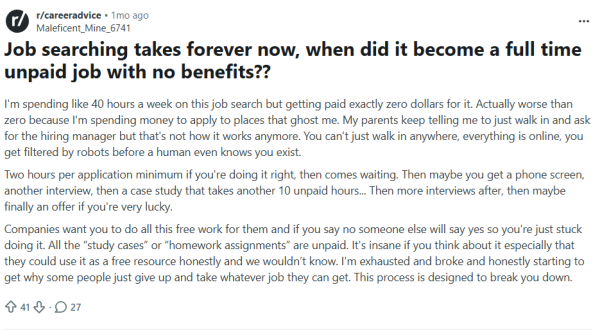
Below is a screenshot from a Reddit forum discussing the pains of job searching.
Finding Jobs
The first step in any job search is identifying roles worth pursuing. This is deceptively time-consuming. Most professionals aren’t looking for just any job—they’re filtering for multiple criteria simultaneously.
Evaluating a single posting can take several minutes if you’re reviewing the job description in detail, cross-checking your qualifications, and checking company reviews. Multiply that by dozens or hundreds of postings, and it becomes a multi-hour exercise just to identify viable roles.
Large job boards are often seen as a valuable time saver, but they introduce their own set of challenges.
Listings are frequently reposted, outdated, or over-saturated with applicants. Browsing these sites can feel like moving in circles—hours can pass as you scroll and filter, only to find that most roles are duplicates or no longer hiring. Many job seekers spend two to four hours in a single session just sorting through the noise.
Beyond the large boards, there’s the company-specific search. Job seekers looking to uncover hidden gems need to check individual company career pages. These updates aren’t aggregated—they must be monitored manually. Doing so might take an hour or more per day if you’re targeting several companies.
Finally, there’s networking and referrals, which is another multi-hour commitment. Reaching out to contacts, drafting personalized messages, and following up on leads adds a layer of labor that is invisible to outsiders.
All this to say…finding jobs you’re actually interested in takes a lot of effort and time.
Submitting Applications
Once your find worthwhile jobs, submitting applications is its own marathon. Each application is far from a single-click process. Every portal has its own quirks, and most require time and effort to do properly.
First, there is the grind of online application forms. Job seekers are routinely required to re-enter the same information (name, address, work history, education, and skills) over and over. Then comes tailoring the Resume which is critical for ensuring you have the right keywords, phrasing, and emphasis.
Screening questions and assessments are another hidden time sink. It’s often overlooked, but these screening questions and assessments require thoughtful answers. You can’t just speed through them. When factoring these in, filling out an application can easily take 30 minutes (or more).
Finally, the sheer volume of applications is a major factor.
In general, it’s common for a job seeker to expect only 2 interviews for every 25 applications. Which means, it can easily take 10–15 hours to generate just a couple interviews (with no guarantees).
Other Hidden Time Costs
Beyond finding roles and submitting applications, there are countless smaller tasks that quietly eat up hours.
Updating your spreadsheet. Responding to recruiter emails or LinkedIn messages. Coordinating interview schedules across multiple companies. Preparing for interviews. Even negotiating offers, reviewing benefits, and completing pre-employment paperwork take time.
All of these tasks are essential, but they often go unacknowledged. When combined with the hours spent searching and applying, they turn the job search into a full-time commitment.
In Conclusion
In conclusion, I hope this article sheds light on Why Applying to Jobs is a Fulltime Job. The job search is a marathon, not a sprint. Between finding roles, applying, interviewing, and managing all the smaller tasks, it demands hours, energy, and focus—just like any full-time job. Recognizing the scope of the work is the first step toward managing it effectively and protecting your time and energy.
If you need help navigating the job search process, my team and I are here to support you. For professional assistance with jump starting your job search, check out Job Concierge or Resume Distribution. Please use the Contact Us to express interest in learning more about our services for jump starting your job search.
About the Author: Doug Levin