

Understanding QRFs (for Federal Job Seekers)

The following post explores the topic of Understanding QRFs (for Federal Job Seekers).
Anyone who has spent time applying for federal jobs quickly realizes that the process is far more intricate than most private-sector hiring, often requiring the submission of detailed written narratives.
Read: Understanding the OF-306 Form (for Federal Job Seekers)
Related: Documents Needed for Applying to Federal Jobs
One of the most confusing and often underestimated requirements is submitting responses to QRFs, which demand tailored explanations addressing specific competencies.
Here’s what you need to know about QRFs.
What Are QRFs?
QRFs, or Quality Ranking Factors, are written narrative responses used by federal agencies to evaluate how well an applicant’s experience aligns with the most important aspects of a specific role.
They are not generic essays and they are not restated Federal Resumes. Instead, QRFs ask applicants to explain, in focused narrative form, how their background demonstrates particular skills, competencies, or experiences that are critical to the position being applied to.
In many cases, QRFs are used to distinguish among applicants who already meet the basic qualifications. This makes them especially relevant for competitive, mid- to senior-level federal roles.
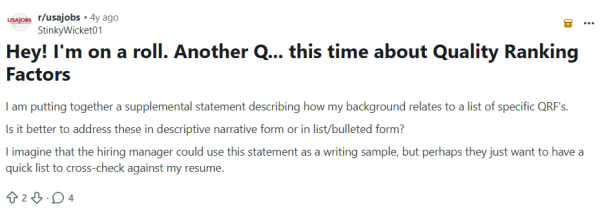
Below is a screenshot from a Reddit forum discussing QRFs.
Why QRFs Exist (and Why They Matter)
Federal agencies often receive hundreds (or even thousands) of applications for a single position, many from candidates who appear qualified based on Federal Resumes alone.
Now that the Federal Resume is limited to two pages (a change that kicked off in September 2025), agencies no longer get those long, detailed breakdowns of your experience right in the Federal Resume. That’s exactly why we’re likely to see QRFs popping up more often: as a replacement for the narrative depth and specific “evidence of impact” that used to be buried in the old 10-page Federal Resume format.
Are All QRFs the Same?
No, unlike the four essay questions for federal jobs, subject matter for QRFs varies from job to job.
One of the most common misconceptions among federal job applicants is that QRFs follow a standardized template across all positions or agencies. In reality, QRF questions are highly customized and vary significantly from one job announcement to another.
While broad themes like leadership, communication, or technical expertise may recur across similar roles, the exact QRFs are unique to the duties, grade level, and priorities of each vacancy.
For instance, a cybersecurity position might emphasize advanced threat analysis or certifications, while a program analyst role could focus on data interpretation and stakeholder engagement.
The key is to carefully evaluate the QRFs listed on the specific job announcement you’re applying to.
Who Must Submit QRFs?
QRFs are indicated as either required (or not required) on a job-by-job basis.
They are most common in professional, technical, legal, policy, and program-related roles (often GS-9 to -14 levels) for titles like Program Analyst, IT Specialist, or Contract Specialist, where agencies look for ‘best qualified’ candidates (rather than simply meeting basic eligibility).
What Makes QRFs Different From a Federal Resume?
While a Federal Resume lists your duties, responsibilities, and achievements in a streamlined way, QRFs are where you prove your talent through a story. It’s the “show your work” section of the process.
You can’t just copy and paste bullets from your Federal Resume and call them your QRFs. Writing strong, evidence-based QRF responses can make all the difference between an invitation to interview (or not).
How Long Should QRF Responses Be?
There is no universal length requirement. The key is to follow the instructions in the job announcement. As a general guideline, most QRFs fall in the range of 200 to 400 words per question.
A Word of Caution About Using AI
You might be wondering if you can use AI to draft your QRF answers.
Federal vacancy announcements increasingly specify that narrative responses must be self-authored. The safest approach is to check the job announcement and follow its instructions exactly.
If the announcement states that responses must be self-authored, that requirement should be taken at face value. Using AI tools or outside consultants can come back to bite you.
It is also important to understand that QRFs are not about producing elaborate answers. Agencies are not looking for literary flair. They are looking for clear, accurate explanations of relevant experience.
The best approach is to self author your responses. Although, you can still use AI to help with selecting the right examples, structuring your responses, and ensuring alignment with the QRF questions.
Sample QRF Questions and Answers
The following examples illustrate the type of questions agencies commonly ask and the level of detail typically expected in a QRF response. Samples are for educational purposes. Applicants should always tailor their responses to the specific vacancy announcement and adhere to stated word or character limits.
- Sample QRF Question #1 – Describe your experience managing complex projects involving multiple stakeholders and competing priorities.
Here’s an example of answering sample QRF question #1
In my current role, I manage projects that require coordination across legal, operations, finance, and external partners, often under tight deadlines and shifting priorities. One representative example involved leading a compliance-driven system implementation affecting multiple business units. The project required aligning regulatory requirements with operational constraints while maintaining continuity of service.
I established a project plan that identified key milestones, decision points, and dependencies, and I worked closely with stakeholders to clarify roles and expectations early in the process. Regular status updates and issue-tracking meetings allowed risks to be identified and addressed before they escalated. When competing priorities arose, I facilitated discussions to balance mission requirements with available resources, ensuring that critical deadlines were met without sacrificing quality or compliance.
As a result of this approach, the project was completed on schedule and passed internal and external reviews without findings. This experience strengthened my ability to manage complexity, communicate effectively with diverse stakeholders, and deliver results in high-accountability environments.
- Sample QRF Question #2 – Demonstrate your ability to analyze policies, regulations, or guidance and apply them to real-world situations.
Here’s an example of answering sample QRF question #2
My professional experience requires frequent analysis of statutory and regulatory requirements and their application to operational decisions. I regularly review federal regulations, agency guidance, and internal policies to assess their impact on programs and procedures.
In one instance, I was tasked with evaluating how newly issued guidance affected an existing program workflow. I conducted a detailed review of the language, identified areas of ambiguity, and compared the guidance against current practices. I then developed a written analysis outlining compliance gaps, potential risks, and recommended adjustments.
I briefed leadership on my findings and collaborated with operational staff to implement changes that aligned with the guidance while minimizing disruption. This effort improved compliance consistency and reduced the likelihood of audit findings. Through this work, I have developed strong analytical skills and the ability to translate complex policy requirements into practical, actionable solutions.
- Sample QRF Question #3 – Describe your experience providing written analysis or recommendations to leadership or decision-makers.
Here’s an example of answering sample QRF question #3
A significant portion of my role involves preparing written analyses to support management decision-making. These documents often require synthesizing complex information, evaluating options, and presenting clear recommendations supported by evidence.
For example, I prepared a briefing memorandum analyzing multiple courses of action related to program resource allocation. This required reviewing performance data, assessing regulatory constraints, and considering operational impacts. I structured the memo to clearly outline background, analysis, risks, and recommended actions, ensuring it could be understood by both technical and non-technical audiences.
Leadership relied on this analysis to make an informed decision that balanced mission priorities with compliance requirements. Feedback emphasized the clarity and usefulness of the written product. This experience reflects my ability to communicate complex issues effectively and support sound decision-making through clear, well-reasoned written work.
In Conclusion
In conclusion, I hope this article helps with Understanding QRFs (for Federal Job Seekers). QRFs can feel unfamiliar and intimidating at first, but they are ultimately a structured way for agencies to understand how your experience aligns with the role. By knowing what QRFs are, why they exist, and how to approach them thoughtfully, you can improve your odds of getting called-in for an interview.
If you’re ready to build your new two-page Federal Resume, my team and I are here to support you. Please use the Contact Us or Submit Your Resume for a risk-free evaluation. JobStars is an A+ BBB-rated service that has earned multiple consecutive Complaint Free Awards. We look forward to hearing from you!
About the Author: Doug Levin