
Top 5 AI Tools Every Job Seeker Needs in 2026
In 2026, perseverance alone is no longer rewarded in the job search. Recruiters use computerized screening, hiring processes accelerate, and competition heats up for almost every position. Seldom do more applications result in better results. The correct applications are submitted.
Successful candidates now approach each stage of the hiring process differently thanks to artificial intelligence. Job seekers utilize AI tools to analyze job requirements, improve applications, get ready for interviews, and develop skills that are in line with market demand rather than speculating about what employers want. As a result, the quest feels purposeful rather than draining.
Five types of AI tools that all job seekers should be aware of in 2026 are examined in this article. Without veering into scholarly or writing-related services, each section emphasizes actual platforms, useful use cases, restrictions, and cost concerns.
Why AI Now Defines the Job Search Process
The amount that recruiters deal with is too great for a human review. Before human review starts, automated systems score candidates, filter resumes, and eliminate mismatches. Clarity, relevance, and structure are given top priority in these systems. Visibility is no longer guaranteed by experience alone.
Candidates can adjust to this reality with the aid of AI tools. They show where resumes fall short, how job descriptions translate into screening criteria, and how employers view applications. Candidates address problems early rather than late.
When used intentionally, this change boosts response rates, saves time, and lessens stress.
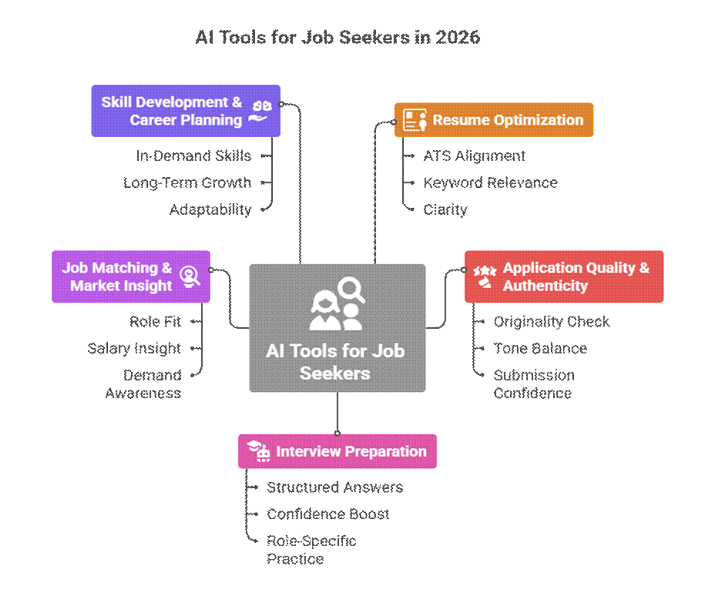
1. AI Resume Optimization Tools
Jobscan · Rezi · Resume Worded
The key component of AI-assisted job searching is still resume improvement. The harmonization of the applicant experience with employer expectations is the main focus of these platforms.
- Jobscan generates match scores and keyword insights based on actual hiring data by comparing resumes to job descriptions.
- Rezi gives users immediate feedback while they edit, pointing them in the direction of forms and language that are preferred by automated systems.
- Resume Worded assesses current resumes and LinkedIn profiles, emphasizing content and structural problems that recruiters frequently point out.
These techniques improve relevance rather than reinventing identity.
| Tool | Pros | Cons |
| Jobscan | Uses real job description data for keyword alignment, clear match scoring, and strong ATS focus | Can encourage keyword overuse if followed blindly; limited customization without a paid plan |
| Rezi | Real-time feedback during editing; clean structure guidance; supports multiple resume versions | Less contextual advice for niche roles; interface favors standardized formats |
| Resume Worded | Strong diagnostic feedback; LinkedIn profile evaluation included; recruiter-focused insights | Suggestions can feel generic; fewer customization controls |
- AI Job Application Quality and Authenticity Tools
EduBrain
Automation speeds up applications, but unchecked automation introduces risk. Employers increasingly assess whether submissions appear intentional, coherent, and credible. Applications that feel overly generated often fail early screening.
In the first half of the job search process, many candidates rely on an AI job application tool to review their materials before submission. A critical step involves evaluating whether AI-assisted text appears overly mechanical. Using an AI detector allows applicants to assess tone, structure, and originality from a screening perspective.
Platforms support this review by helping candidates refine applications so they remain professional, consistent, and believable. This approach does not replace judgment; it strengthens it by reducing unnecessary rejection during automated review.
Why this step matters
- Screening systems flag unnatural language patterns
- Over-automation signals low effort
- Balanced AI use improves trust
3. AI Interview Preparation Platforms
Google Interview Warmup · Yoodli · ChatGPT
Static question lists are no longer the only way to prepare for interviews. These days, AI systems mimic interview settings according to seniority, industry, and job.
- Candidates can practice job-related responses and find gaps using Google Interview Warmup.
- Yoodli provides feedback that enhances delivery by analyzing speech clarity, pace, and filler usage.
- ChatGPT facilitates organized mock interviews that improve explanation and flow when directed by job descriptions and individual context.
Under pressure, these methods assist candidates in clearly communicating their experiences.
| Tool | Pros | Cons |
| Google Interview Warmup | Role-specific prompts; simple interface; no cost barrier | Limited depth; no advanced feedback on delivery |
| Yoodli | Detailed speech analysis, pacing, and clarity insights; strong delivery feedback | Best value requires subscription; less focus on content depth |
| ChatGPT | Highly flexible; adapts to job descriptions; supports mock interviews | Output quality depends on prompt quality; no built-in performance metrics |
- AI Job Matching and Market Insight Tools
LinkedIn Premium · Teal · Indeed AI
Openings are listed on traditional employment boards. They are interpreted by AI-powered platforms.
- LinkedIn Premium provides salary data and assesses role suitability and profile alignment.
- Teal integrates market information, job monitoring, and resume tools into a single workspace.
- Based on hiring trends, experience, and behavior, Indeed’s AI-powered recommendations highlight positions.
Candidates concentrate their efforts where the likelihood is greater rather than applying widely.
| Tool | Pros | Cons |
| LinkedIn Premium | Profile-job fit insights; salary transparency; recruiter visibility | Subscription cost: recommendations vary by profile quality |
| Teal | Centralized job tracking, resume integration, and market insight tools | Learning curve for new users; some features are locked behind paid plans |
| Indeed AI | Large job database; personalized role suggestions; free access | Less granular insight; limited customization controls |
This approach reduces wasted effort and improves application tracking across roles and industries.
5. AI Skill Development and Career Planning Tools
Coursera AI Paths · LinkedIn Learning · IBM SkillsBuild
Getting a job just addresses a portion of the problem. Adaptability is essential for long-term employability. Development routes are increasingly customized by AI-driven learning systems according to career objectives and hiring needs.
- LinkedIn Learning and Coursera evaluate job requirements and suggest specific skills.
- IBM SkillsBuild focuses on certifications that enhance employability in both technical and non-technical roles and are aligned with industry standards.
Candidates focus their efforts where there is a need rather than haphazardly upskilling, which promotes long-term professional development.
| Tool | Pros | Cons |
| Coursera AI Paths | Industry-recognized courses; structured learning tracks; certification options | Some courses require payment; time commitment varies |
| LinkedIn Learning | Strong integration with profiles; short, practical courses; broad catalog | Certifications carry less formal weight; depth varies by topic |
| IBM SkillsBuild | Employer-aligned content; focus on employability skills; free access | Limited course variety; slower content expansion |
How These Tools Work Best Together
When utilized as a system as opposed to separately, AI tools produce the best outcomes. Without a plan, individuals who stack platforms frequently provide inconsistent results.
This is an example of a practical workflow:
- Tools for market understanding find feasible positions
- Platforms for resumes link documents
- Final manuscripts are reviewed by validation tools
- Platforms for interviews improve communication
- Future readiness is guided by learning resources
This framework keeps each step deliberate and avoids overuse.
Comparison Snapshot of Key AI Tools
| Category | Example Platforms | Primary Use |
| Resume Optimization | Jobscan, Rezi | ATS alignment |
| Application Validation | EduBrain, GPTZero | Authenticity review |
| Interview Preparation | Yoodli, ChatGPT | Interview readiness |
| Job Matching | Teal, LinkedIn | Opportunity focus |
| Skill Development | Coursera, IBM | Career planning |
Common Mistakes Job Seekers Still Make With AI
Despite access to advanced tools, misuse remains common.
Frequent issues include:
- Copying generated text without review
- Repeating identical phrasing across applications
- Ignoring role-specific context
- Skipping validation before submission
AI improves outcomes only when paired with intent and judgment.
What Recruiters Actually Notice in 2026
Hiring teams expect candidates to use modern tools but not carelessly. Recruiters notice:
- Clear alignment with role requirements
- Consistent language across materials
- Natural explanations during interviews
- Evidence of targeted skill development
They also notice when automation replaces thinking.
Why AI Will Remain Central to Hiring
Automation won’t give up on hiring procedures. Structured review becomes necessary as businesses grow. Those who are familiar with these systems have an advantage.
Applicants may move more quickly, communicate more effectively, and concentrate their efforts where they will yield results with the use of AI tools. They increase relevance while lowering burnout.
Final Thoughts
In 2026, credibility, flexibility, and clarity are essential for successful job searches. Every significant step of the procedure, from finding opportunities to preparing for interviews, is now supported by AI tools. When applied appropriately, they enhance applications without eliminating uniqueness.
Candidates who apply with a purpose and use the appropriate tools and techniques are more likely to succeed than those who apply the most.
Key Takeaways
- Since hiring systems mostly rely on automated screening and data-driven evaluation, AI technologies have become a practical necessity for job searchers in 2026 rather than an optional benefit.
- Platforms for resume optimization assist applicants in matching their experience to what employers require, increasing visibility without changing their personal identities.
- By guaranteeing that AI-assisted content stays coherent, deliberate, and credible, application quality and authenticity checks lower the danger of early rejection.
- Tools for interview preparation mimic actual recruiting situations, assisting candidates in confidently communicating their experiences and organizing their answers.
- By directing candidates toward positions where skills, demand, and pay coincide, job matching and market insight tools help cut down on the number of unsuccessful applications.
- By concentrating learning efforts on in-demand competencies, hiring data-driven skill development solutions promotes long-term employability.
- It is more effective to use numerous AI technologies in a systematic workflow as opposed to on an as-needed basis.
- Recruiters still need careful, role-specific solutions, so over-automation is still a prevalent error.
- In competitive employment markets, candidates who strike a balance between human judgment and AI efficiency have a quantifiable edge.
- The most successful job applicants in 2026 will apply with purpose, clarity, and flexibility, bolstered by ethically applied AI tools.
About the Author: Doug Levin