
Resume Page Length
The following post explores the topic of Resume Page Length.
One page, two pages, or three pages? If you’re unsure how long your Resume should be, you’re not alone. Depending on your occupation, industry, and seniority level the answer may vary.
Read: Dealing with a Long Employment Gap
Related: Best and Worst Resume Services on BBB
When putting together an ATS-friendly and visually appealing Resume, page length is an important consideration. Too long and it runs the risk of being excessive; too short and it’s selling you short.
Here’s what you need to know.
Overview
Experience level is one of the key determinants when it comes to deciding the ideal Resume length, as it influences how much detail is necessary to showcase your qualifications.
However, other factors, such as your industry or occupation may also play a role. For instance, creative roles may allow for more flexibility, while board roles may favor a more structured format.
The One-Page Rule is a Myth
The one-page myth suggests that all job applicants should limit their Resumes to one page, regardless of experience. However, this oversimplifies the process and ignores the diverse backgrounds of candidates.
Consider this logic…
Think about your job search like a traditional advertising and marketing campaign. You are the item for sale, in a marketplace where employers are shopping for talented individuals.
Consider McDonald’s advertising strategies. McDonald’s applies a variety of tools and creativity to effectively market their products to different audiences. Happy meals are available for children, value-menu options for cost-cutters, and deluxe burgers for those looking to indulge.
What’s the moral of the story? One generalization or strategy does not guide their overall marketing approach, and effective messaging comes in all shapes and sizes.
The one-page rule fails to account for the differences between seniority level. A rigid one-page limit forces applicants to condense important details.
Ultimately, a Resume should be as long as needed to effectively showcase your qualifications, not dictated by arbitrary page limits.
Pictured below is a screenshot from a Reddit discussion about the one-page ‘rule’.
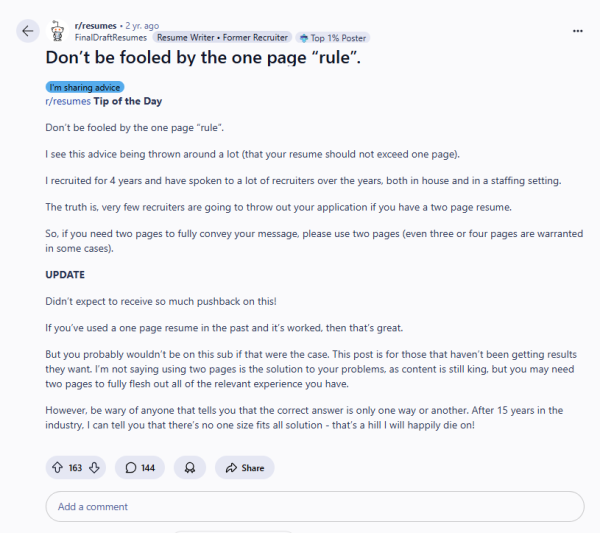
Pictured: Screenshot from Reddit discussion about one-page ‘rule’.
One Page
If you’re a 22-year-old coming out of undergraduate studies, then a one-page Resume makes sense. At this stage, your focus should be on internships, coursework, extracurriculars, and transferable skills.
What to include:
- Education (degree, institution, graduation date)
- Relevant coursework or academic projects
- Internships or volunteer work (if applicable)
- Skills (technical or soft skills)
- Certifications (if applicable)
- Achievements or leadership roles in clubs or student organizations
Two Pages
If you’re a seasoned professional with several years of experience and notable accomplishments, a two-page Resume is more appropriate. By this stage, you likely have enough experience to cover two pages.
What to include:
- A comprehensive work history with job titles, responsibilities, and achievements
- Leadership roles or team management experience
- Notable projects or accomplishments with measurable outcomes
- Industry-specific skills, certifications, or training
- Publications, presentations, or speaking engagements (if relevant)
- Professional affiliations or memberships
Three Pages
For professionals with a long and detailed work history, including those with numerous publications, affiliations, certifications, and other accomplishments, a three-page Resume may be appropriate.
What to include:
- A detailed, chronological work history with key contributions and measurable impacts
- Extensive leadership experience, including high-level decision-making roles
- Specialized skills or niche expertise that may require detailed explanation
- Multiple examples of significant projects or initiatives
- Awards, honors, or recognitions that demonstrate professional excellence
- Publications, patents, or other notable professional achievements
- Volunteer or board positions that showcase leadership or community engagement
LinkedIn Profile
Another important consideration in the page length debate is your LinkedIn profile.
Your Resume doesn’t stand alone – it works in tandem with your LinkedIn profile. Transferring some details from your Resume to LinkedIn allows both to complement each other effectively.
By doing this, you can avoid overloading your Resume with details that might not fit. Instead, you can display those items on LinkedIn, where space isn’t as limited, and keep your Resume focused and concise.
In Conclusion
In conclusion, I hope this post helps clarify the ideal Resume page length. In my opinion, one or two pages is typically best unless there are extenuating circumstances that call for something longer.
About the Author: Doug Levin