
Exploring a Career in Higher Education (in 2026)

The following post takes a closer look at Exploring a Career in Higher Education.
Are you considering a career in higher education? If you’re thinking about working in higher education, it’s reasonable to pause and ask whether it’s the right move.
Read: Understanding the Hidden Job Market
Related: Education Professional Associations & Organizations
Working in higher education has long been viewed as a stable and respectable career path, but many job seekers today are unsure what that actually means in practice.
Here’s what you need to know.
Overview
Employment at colleges and universities is one of the largest and most established employment sectors in the country, supporting millions of jobs across teaching, administration, research, and student services.
However, the world of higher education is undergoing a major transformation due to significant geopolitical factors including economic pressure, political uncertainty, and demographic change.
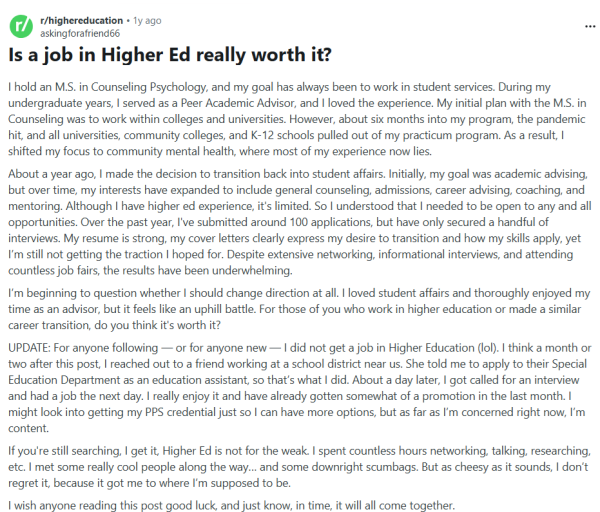
If you’re considering getting into higher education, there are some important factors to consider. Pictured below is a screenshot from a Reddit forum discussing employment in higher education today.
A Quick Note
I want to be clear about my perspective from the outset. I do not work in higher education, and I’m not writing this as an insider or academic expert. I’m approaching this from the outside, looking at the big picture (economic trends, political developments, and employment patterns) with the goal of helping job seekers make sense of whether higher education is a smart place to build a career right now.
Crisis in Higher Education
It’s no secret that there’s an ongoing crisis in higher education.
Declining enrollment, rising costs, public skepticism, and increased political scrutiny have made it a widely acknowledged reality discussed across mainstream media, policy circles, and within the industry itself.
To be fair, lots of industries are in crisis these days. It’s not like higher education won’t survive. But, if you’re seriously considering a career in this space it’s important to recognize the situation for what it is.
Declining Enrollment
One of the most fundamental challenges is the decline in traditional college-aged students in the US.
Demographic trends have been moving in this direction for years, and many institutions are now feeling the impact directly through lower enrollment and tighter budgets.
Declining enrollment is a problem that, if left untreated, leads to trouble like layoffs, furloughs, and asking existing employees to ‘do more with less’. Growth isn’t the focus. It’s about maintaining the status quo.
Foreign Students
For some time now, colleges and universities have relied heavily on international students to offset declining domestic enrollment. It has been a financial boon that has helped institutions maintain enrollment numbers at a time when fewer U.S. students are enrolling in college.
However, it’s increasingly become a potential source of vulnerability.
International enrollment has been a topic of heated discussion lately. In 2025, the U.S. government announced plans to allow a significant number of Chinese students to study in the United States. In the near term, this was good news for the sake of stability in the higher education system.
The key takeaway here is the current system has been propped up by foreign student enrollment for many years. In an increasingly tense geopolitical climate, that could become a bigger problem.
Oversaturation and Institutional Consolidation
Another structural issue facing higher education is scale.
The United States has built a large and complex ecosystem of colleges and universities over many decades, often operating under the assumption of steady or growing demand.
As that assumption weakens, the size of the sector itself becomes harder to sustain.
In 2025 alone, at least 16 nonprofit institutions announced closures due to enrollment and financial challenges. Beyond closures, there are also mergers, program eliminations, departmental restructuring, and staffing reductions which can have a big impact on employees.
The Case for Working in Higher Education
As discussed, there are some unavoidable issues within higher education, but it’s not all bad. There are still real reasons why people choose to work in higher education (and continue to stay).
One of the biggest draws is predictability. Compared to many private-sector roles, higher education jobs often come with more stable work hours and fewer last-minute demands. Academic calendars, scheduled breaks, and established institutional routines can make day-to-day work feel more manageable (particularly for administrative and professional staff).
Higher education also offers stable, specialized career paths that don’t require constant job hopping to move forward. Roles in areas like financial aid, registrar operations, compliance, institutional research, academic advising, and grants management tend to reward experience and institutional knowledge. This is good for people who prefer to build depth in a role rather than constantly chasing the next title.
Finally, for some, the work itself still matters. Higher education remains one of the few sectors centered on teaching, learning, and research rather than quarterly results. While academic career paths are more constrained than they once were, teaching-focused and research-adjacent roles continue to exist. Contributing to education or student development can be reason enough to accept the tradeoffs.
In Conclusion
In conclusion, I hope you find this article helpful when Exploring a Career in Higher Education. There are many factors to consider. Whether it’s a good move ultimately depends on what you value and how comfortable you are with the potential risks and tradeoffs.
If you’re ready for professional help to building an interview-winning Resume, please fill out the Contact Us form or Submit Your Resume for a risk-free evaluation. JobStars is an A+ BBB-rated service that has earned multiple consecutive Complaint Free Awards. We look forward to hearing from you!
About the Author: Doug Levin