
Listing Education on a Resume Without a Degree
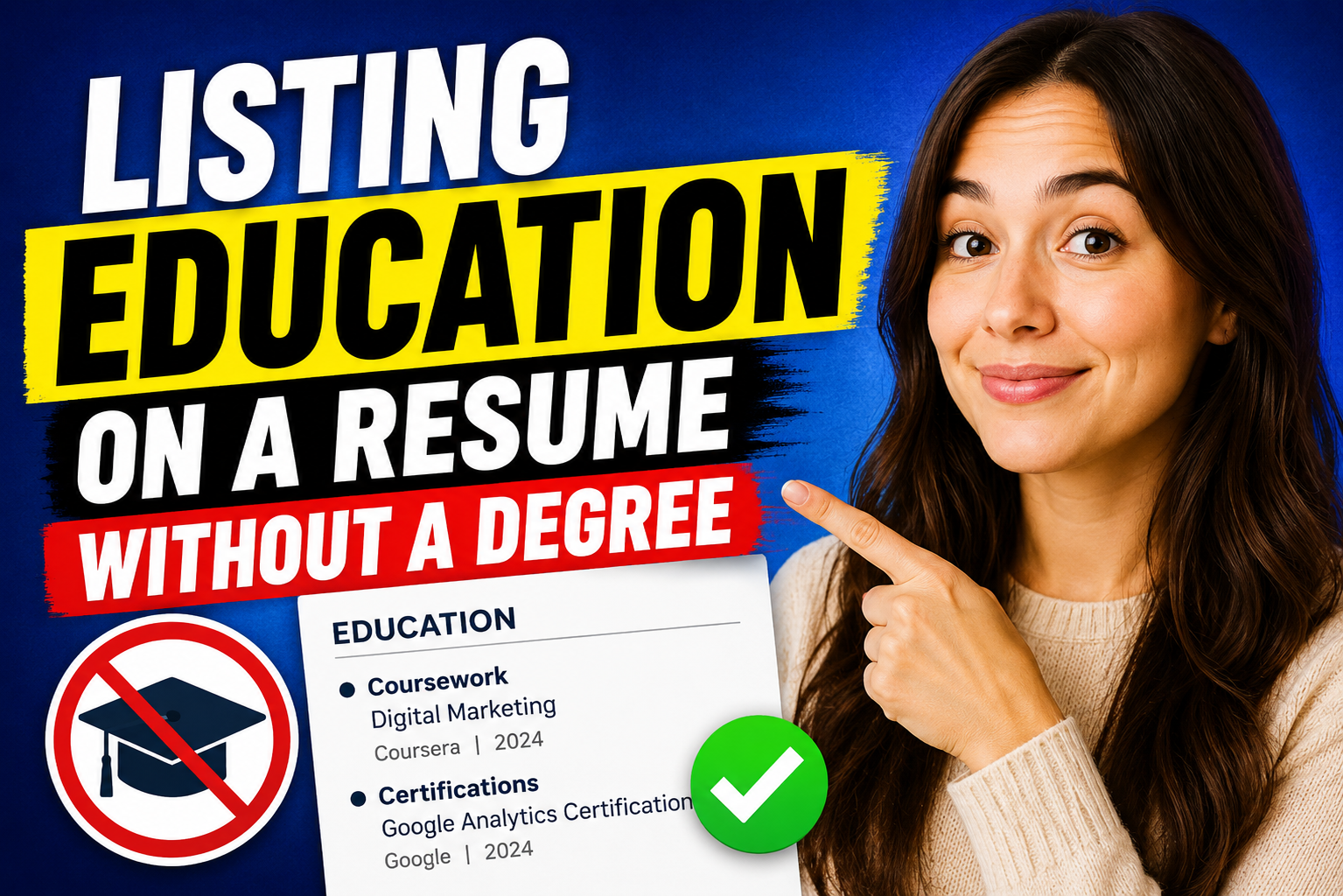
The following post explores the topic of Listing Education on a Resume Without a Degree.
Should your include high school? What about college credits without graduating? These are the common questions that run through the minds of job seekers without a college degree.
Read: Understanding Your Resume’s Audience
Related: Using Credentials After Your Name On a Resume
Figuring out what to write in the education section of your Resume can be confusing if you didn’t attend (or finish) college.
Here’s what you need to know.
Overview
Not having a college degree can raise valid concerns when you’re putting together a Resume. The traditional emphasis on formal education has long shaped how hiring managers screen applicants.
There’s no shortage of opinions on how to handle the education section when you don’t have a degree. Some folks suggest leaving it off entirely, others recommend listing incomplete college experience.
It’s a debated topic without a one-size-fits-all answer – what works best depends on your background, the roles you’re targeting, and how much weight is placed on formal education in your industry.
Below is a screenshot from a Reddit forum discussion about listing education without a degree.

When You Attended College But Didn’t Finish
If you started college but didn’t earn a degree, it’s still worth listing that experience. College coursework (completed or not) shows exposure to curriculum that may be relevant to employers.
Just make sure it’s clear that a degree wasn’t awarded. You don’t want to give the impression that you graduated when you didn’t, as that could backfire during background checks or interviews.
List the name of the school, your field of study, and the years attended. You can also add a phrase like “Completed coursework toward…” or “Studied [major]” to give context. Remember to avoid including a graduation date or formatting it in a way that implies completion. Well-structured resume templates can help keep this information clear while maintaining a consistent layout throughout the document.
For example:
- University of Texas – Business Administration (2018–2020)
- Completed coursework toward B.S. in Marketing, University of Illinois
- Studied Computer Science – Georgia State University (no degree earned)
When You Never Attended College But Finished High School
If high school is your highest level of formal education, simply state that in the education section. There’s no need to explain why you didn’t attend college – just present the credential clearly and move on.
You can include the school name and location, or just the diploma type and city or state.
For example:
- High School Diploma – Denver, CO
- GED – State of New York
- Lincoln High School, Chicago, IL – Graduated 2017
When You Never Finished High School
If you didn’t complete high school, you can still include the name of the high school and the years attended – but be careful not to imply completion.
For example:
- Springfield High School – Attended through 11th grade
- Jefferson High School, Chicago, IL – Coursework completed, no diploma
Highlighting Certifications and Training
If you’ve completed certifications or technical training, these can serve as a strong stand-in for education – especially in industries where practical skills are more important than a degree.
Certifications show employers that you’re qualified, credible, and serious about your field. For safety-oriented roles, candidates often highlight workplace safety training to demonstrate baseline readiness.
For example, CompTIA offers some of the most widely-recognized IT certifications in the industry. If you’re thinking about pursuing CompTIA certification, I recommend practicing with CompTIA practice questions to improve your readiness for certification exams.
I recommend listing certifications in the education section of your Resume under its own heading such as ‘professional development’.
For example:
- Certified Welder – American Welding Society
- Project Management Professional – Project Management Institute
- Google IT Support Certificate – Coursera
- Licensed Real Estate Agent – State of Florida
- Senior Professional in Human Resources – Society for Human Resource Management
- ServSafe Certification – National Restaurant Association
Why You Shouldn’t Leave the Education Section Blank
Even if your academic background is minimal, leaving the education section blank can hurt your Resume’s performance with applicant tracking systems (ATS).
Most ATS scan Resumes expecting to find something in the education field. An empty section might signal missing information or disqualify you in automated screenings.
Even a brief, honest entry like “High School Diploma” or “Completed coursework in…” can help satisfy ATS requirements and ensure your Resume gets through the initial filters.
In Conclusion
In conclusion, I hope this helps with handling the education section of your Resume without a college degree. I know it can be a source of anxiety, but hopefully this offers some clarity on how to handle it.
If you’re interested in professional assistance with building your Resume from an A+ BBB-rated service that has earned multiple consecutive Complaint Free Awards, please fill out the Contact Us form or Submit Your Resume for a risk-free evaluation. We look forward to hearing from you!
About the Author: Doug Levin