

Using Credentials After Your Name On a Resume

The following post explores the topic of Using Credentials After Your Name On a Resume.
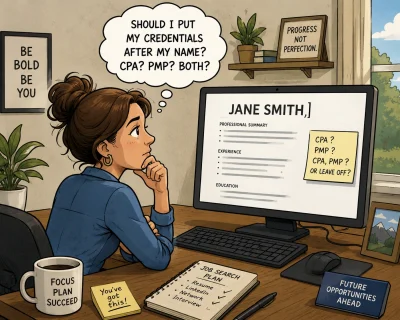
When formatting your Resume, a common dilemma arises: Should you list professional credentials after your name? Or save them for the education and certifications section?
Read: Listing Education on a Resume Without a Degree
Related: Resume Writing Standards and Best Practices
While credentials can signal expertise and professionalism, knowing when and how to use them is key. This post takes a closer look at the topic and helps you better understand to include your credentials.
Here’s what you need to know.
Overview
In today’s competitive job market, every detail on your Resume plays a role in shaping a recruiter’s first impression.
Using credentials after your name is a subtle decision that can either reinforce your professionalism or feel unnecessary. Industry norms, role requirements, and the credential’s relevance all factor into whether it adds value or clutters your presentation.
At its core, the decision to include a credential after your name is about communicating your education. It’s a way of calling attention to a qualification you believe sets you apart.
When It’s Not Recommended
It’s generally not customary to list a bachelor’s degree (or any undergraduate credential) after your name on a Resume. While degrees like a BS or BA are valuable, they are considered standard qualifications that don’t require a special callout.
Adding something like ‘Joe Smith, BS’ to your Resume header doesn’t enhance credibility. Instead, it can come off as trying too hard or misunderstanding professional norms.
When It’s Borderline
Including a master’s degree after your name is a borderline decision. It can add value in some contexts, but often isn’t necessary.
Degrees like MBA (Master of Business Administration) are widely held and generally expected in many business-related roles, so placing it after your name doesn’t offer much differentiation.
On the other hand, a more specialized degree, such as ‘Joe Smith, MEng’ may warrant inclusion. Earning a Master of Engineering is more specialized and less common than an MBA.
When It’s Definitely Appropriate
Listing a doctorate-level credential after your name is absolutely appropriate, especially in fields where advanced academic or professional specialization is the norm.
Whether you hold a PhD, JD, EdD, or MD, including it after your name signals authority, expertise, and years of rigorous training.
In academia, law, medicine, and research-intensive fields, this type of credential reinforces your professional identity and is both expected and respected in Resume headers.
When It Adds Strategic Value
Specialized certifications add strategic value when they clearly signal job-relevant expertise. Credentials like SPHR, PMP, CPA, or CFA are often directly tied to job qualifications and indicate advanced competence.
If the certification is well-known in your industry and directly applicable to the role, including it after your name, for example ‘Joe Smith, PMP’ can make your Resume stand out at a glance. These types of professional designations are not only acceptable, but often advisable.
In Conclusion
In conclusion, I hope this article sheds some light on Using Credentials After Your Name on a Resume. While there’s no absolute right or wrong, these are the customary practices that can help guide your approach. When in doubt, focus on the designations that are most recognized in your field and most relevant to the position you are pursuing.
If you’re ready for help with building your new Resume, my team and I are here to support you. Please use the Contact Us or Submit Your Resume for a risk-free evaluation. JobStars is an A+ BBB-rated service that has earned multiple consecutive Complaint Free Awards.
About the Author: Doug Levin