

Understanding the SF-86 Form (for Federal Job Seekers)
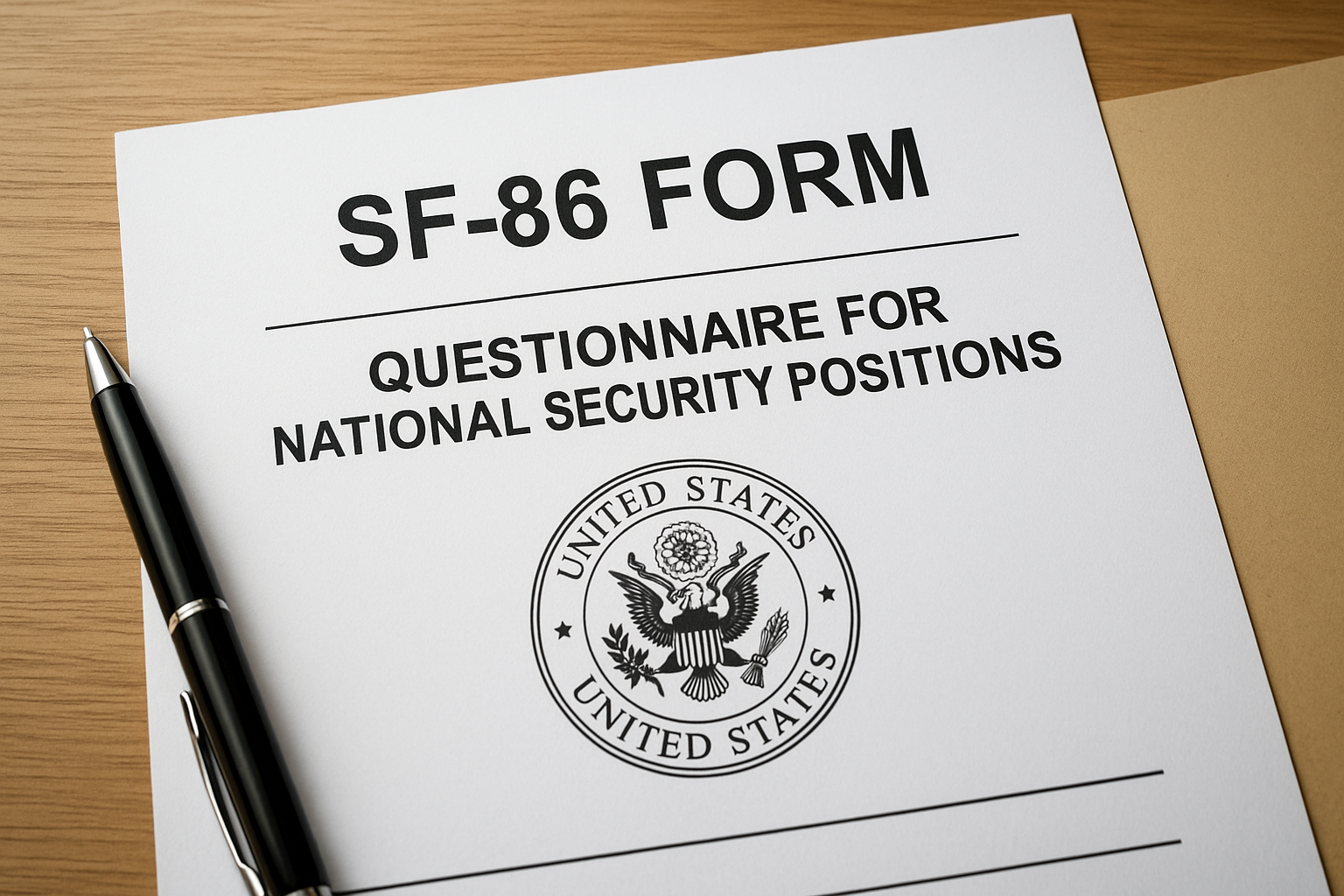
The following post takes a look at Understanding the SF-86 Form (for Federal Job Seekers).
You’ve applied for a federal job that sounds perfect — good mission, steady pay, and the kind of position that might eventually involve sensitive or security-related responsibilities.
Read: Best Federal Resume Writing Services
Related: Understanding the OF-306 Form (for Federal Job Seekers)
Then HR mentions there’s one more step. It’s a lengthy, deeply personal questionnaire that asks about nearly every corner of your life. It’s the Standard Form 86, better known as the SF-86.
Here’s what you need to know.
What is the SF-86?
In a nutshell, the SF-86, formally referred to as the ‘Questionnaire for National Security Positions’, is the U.S. government’s standard background-investigation form used to collect detailed personal history for applicants being considered for national security positions and security clearances.
The SF-86 is an extensive form asking about identity, residences, employment, education, foreign contacts and travel, financial history, criminal history, drug and mental-health history, and many other topics that help investigators assess reliability, trustworthiness, and allegiance.
Who Needs to Fill It Out?
The SF-86 is required for anyone being considered for a position that involves access to classified information or duties affecting national security. That includes applicants for federal employment, current federal workers moving into sensitive roles, and contractors whose work requires security clearance eligibility.
Even individuals who already hold a clearance may be asked to complete or update the form when renewing or upgrading their clearance level, transferring between agencies, or undergoing a periodic reinvestigation.
In other words, the form is a universal entry point for roles touching national security in any capacity.
What Information Does It Ask For?
Completing the SF-86 means providing a comprehensive snapshot of your personal and professional life. The form requests identifying details such as your name, aliases, citizenship, and Social Security number, along with a record of every address you’ve lived at for the past seven to ten years.
It also asks for your full employment and education history, including supervisors, references, and explanations for any gaps in work or school. Beyond that, you’ll disclose information about family members, close associates, and cohabitants, as well as any foreign travel, contacts, or financial interests.
The form digs into financial history (debts, bankruptcies, tax issues) and seeks transparency on criminal charges, drug use, mental-health treatment, and even prior misuse of computer systems or legal disputes.
Many questions have no time limit, requiring disclosure of “ever” events, while others cover only specific lookback periods. The expectation is total completeness, supported by documentation wherever possible.
When Must You Fill It Out?
Most federal job seekers encounter the SF-86 as part of the pre-employment process after receiving a conditional offer for a position designated as sensitive or requiring a clearance.
Once a sponsoring agency confirms that your prospective role involves access to classified information or national security systems, they’ll initiate your background investigation and provide instructions to complete the SF-86, often through the electronic e-QIP system.
In some cases, you may complete it during an upgrade to a higher clearance level or as part of your regular reinvestigation cycle, which can occur every five to ten years (depending on the clearance type). The timing may vary by agency, but the request to complete the SF-86 always marks the start of a formal vetting process.
How Is It Submitted?
Most agencies today process the SF-86 electronically through e-QIP (Electronic Questionnaires for Investigations Processing), a secure web-based portal managed by OPM. Paper copies are only accepted in special cases, so most applicants will work entirely within the electronic system.
You’ll receive login credentials and instructions from your agency’s security or HR office. Once completed, the form is submitted through the portal, where it is encrypted and transmitted directly to the investigative service that will conduct your background check.
What Happens After Submission?
The duration of the clearance process varies widely depending on the position’s sensitivity, the complexity of your background, and agency workload. Once you submit your SF-86, the sponsoring agency forwards it to the investigative service which begins verifying your information.
Investigators review public and private records, check criminal and credit histories, and may conduct in-person or phone interviews with you, your references, employers, and even neighbors. After the investigation concludes, the results are sent to an adjudicator who evaluates the findings and makes a determination.
The full process can take anywhere from several weeks to several months, depending on backlogs and the depth of follow-up required.
How to Approach the SF-86 Form
Honesty and preparation are essential. Even minor omissions can raise concerns during adjudication, so it’s far safer to disclose fully than to conceal information that could later emerge through investigation.
Before beginning, gather your records — old tax returns, lease agreements, contact information for supervisors, travel dates, and other documentation — to ensure accuracy. Drafting answers offline before entering them into e-QIP helps you stay organized and prevent timeouts or data loss.
If you’re unsure how to respond to questions about sensitive topics like mental-health treatment or foreign contacts, consult your security officer rather than guessing. Remember that investigators are trained to weigh context and mitigation; what matters most is evidence of honesty, responsibility, and stability.
In Conclusion
In conclusion, I hope this article helps you with understanding the SF-86 form. Completing the SF-86 may feel invasive, but it’s a necessary step in protecting national security and maintaining trust across the federal workforce by giving investigators exactly what they need to make a fair and timely decision.
If you’re ready to build your new two-page Federal Resume, my team and I are here to support you. Please use the Contact Us or Submit Your Resume for a risk-free evaluation. JobStars is an A+ BBB-rated service that has earned multiple consecutive Complaint Free Awards. We look forward to hearing from you!
Download the SF-86 Form (PDF)
About the Author: Doug Levin