

Understanding the Federal Hiring Timeline

The following post takes a closer look at Understanding the Federal Hiring Timeline.
Are you applying to federal jobs and wondering about the steps involved in the federal hiring process? It’s a layered and bureaucratic process that involves multiple steps from start to finish.
Read: Building Your Two-Page Federal Resume
Related: Best Federal Resume Writing Services
Unlike the private sector (where hiring decisions often happen quickly), federal hiring often involves more red tape and multiple review stages before a final decision is made.
Here’s what you need to know.
Overview
The federal hiring process follows a fairly structured timeline.
The evaluation and onboarding process typically passes through multiple administrative, evaluative, and approval-related stages designed to assess qualifications, verify eligibility, complete pre-employment requirements, and finalize the hiring decision.
While the exact process can vary by many factors, this overview should help provide a realistic picture of how federal hiring typically progresses from application to onboarding.
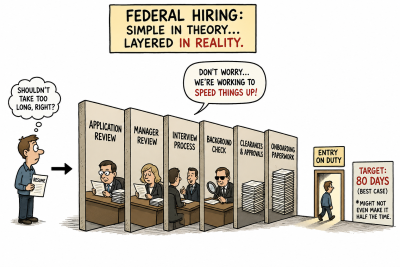
Below is a general breakdown of the major stages commonly involved in the federal hiring process.
Phase 1: Application and Initial Review
👉 Application Submitted: This step represents the submission of your application (including a two-page Federal Resume) through USAJOBS or the appropriate federal portal.
👉 Application Closed: The closing date marks the end of the application period. After this, HR reviews submissions for basic eligibility and qualifications.
Phase 2: Referral and Interview Process
👉 Referred to Hiring Manager: If your application passes the initial screening, it’s sent to the hiring manager which indicates you’re a competitive candidate. You will be notified that you’ve been referred for further review and potential interview.
👉 Interview Conducted: This step involves meeting with a panel or individual interviewers to assess your qualifications for the role. The focus is on determining how well your skills and experience align with the job’s requirements.
Phase 3: Selection and Conditional Offer
👉 Notice of Selection: This step represents being notified that you’ve been chosen for the role (pending further steps like suitability and security clearances).
👉 Tentative Job Offer (TJO): The TJO outlines the position details (pay, location, start date) and is contingent on successful completion of pre-employment requirements.
Phase 4: Background and Suitability
👉 Fingerprint Appointment: This step involves submitting your fingerprints at a designated location to begin the identity verification and criminal history check process.
👉 SF-85 (Background Check): The SF-85 form collects detailed information about your personal history, employment, and financial background (for evaluating your trustworthiness and eligibility).
👉 Suitability Investigation Approved (SID): Following the submission of the SF-85, the agency conducts a more in-depth review of your background including examining your criminal history, financial standing, and other factors.
Phase 5: Final Approvals
👉 Recruitment Package Sent for Approval: HR finalizes your recruitment package and submits it for agency-level approval.
👉 Notice of Disposition Email Received: This email confirms your status and provides additional instructions (including details about the next steps).
Phase 6: Onboarding and Finalization
👉 EOD Coordination Email: This step involves coordinating with HR to finalize the logistics for your first day on the job. You’ll receive an email outlining key details (paperwork, reporting instructions, orientation schedule, etc).
👉 Final Job Offer (FJO): FJO is the official confirmation that you’ve successfully completed all pre-employment steps and are formally hired for the position. The FJO outlines the terms of employment (start date, pay grade, etc).
👉 Entry on Duty (EOD): EOD marks your official first day at the agency. At this point, you’ll begin the onboarding process which includes completing any final paperwork, attending orientation sessions, etc.
Additional Considerations
👉 Veterans’ Preference Review: If you’re a veteran, your eligibility for veterans’ preference may need to be evaluated before referrals or job offers are extended.
👉 Drug Testing: Certain federal positions require drug testing (after the TJO).
👉 Security Clearance: The security clearance process involves more extensive background checks and investigations for positions requiring a higher level of security clearance (can extend the timeline).
👉 Medical Examinations: For some federal jobs, you may be required to undergo a medical evaluation to ensure you meet the physical health standards for the position.
How Long Does the Process Take?
Officially, federal agencies are expected to complete the hiring process within 80 days from the closing date of the job announcement to the tentative job offer (TJO).
In 2025, OPM rolled out the Merit Hiring Plan which included initiatives to speed up federal hiring timelines. Prior to these reforms, it was not uncommon for the same general hiring process to take well over 150 days from application closing date to tentative offer.
While 80 days is the new standard, it’s still possible for the timeline to exceed 80 days (based on the agency, position, security requirements, internal delays, and more).
It’s Still Slow in Reality
Despite the expedited timeline, the federal hiring process remains notoriously slow.
Think about it. The federal government specifically introduced reforms to speed up hiring. Yet, the target timeline is still 80 days from the closing date of the job announcement to entry on duty.
That’s nearly 3 months! Just to evaluate applicants, make a selection, and onboard that person.
Comparatively, in the private sector, companies can review applicants, conduct interviews, extend an offer, and onboard an employee within a matter of days or weeks. When applying to federal jobs, it’s important to anticipate a longer timeline, factoring in all the various steps and planning accordingly.

In Conclusion
In conclusion, I hope this article is helpful for understanding the federal hiring timeline. While it can certainly be a cumbersome process, you’re now informed on the specific milestones and administrative requirements necessary to manage the application lifecycle.
If you need help navigating the federal job search process or building your two-page Federal Resume, my team and I are here to support you. Please use the Contact Us or Submit Your Resume for a risk-free evaluation. We look forward to hearing from you!
About the Author: Doug Levin