

Situations for Using the Keirsey Career Temperament

The following post explores Situations for Using the Keirsey Career Temperament.
Have you ever questioned what truly motivates you at work—or why certain roles, environments, or responsibilities seem like a natural fit while others feel like an uphill battle?
Read: Understanding Your Resume’s Audience
Related: Gauging Your Job Search Effectiveness (with PDF Worksheet)
Personality assessments like the Keirsey Career Temperament are designed to help explore those questions by offering insight into how you naturally think, communicate, and approach work.
Here’s what you need to know.
Keirsey Overview
The Keirsey Career Temperament is a personality-based assessment that helps individuals better understand how their natural traits may influence behavior, communication, and decision-making. Developed by Dr. David Keirsey, the framework groups personalities into four primary temperaments, with sixteen more specific personality types beneath them.
In professional settings, the assessment is commonly used as a self-awareness tool for exploring career compatibility, workplace preferences, and broader career-related questions.
👉 Download the Sample Keirsey Career Temperament Report (PDF)
Four Personality Types
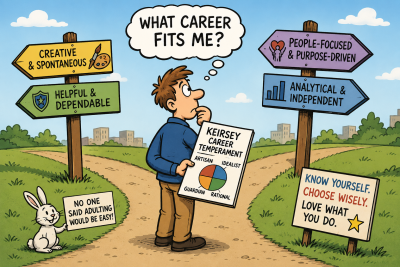
The framework for the Keirsey Career Temperament is there are essentially four main personality types. Underneath those four main personality types are 16 different types of people.
👉 These Are the Four Main Personality Types:
- Artisan (30% to 35% of population) – typically bold and spontaneous.
- Guardian (40% to 45% of population) – typically helpful and dutiful.
- Idealist (15% to 20% of population) – typically spiritual and intuitive.
- Rational (5% to 10% of population) – typically ingenious and independent.
Selecting a Career Path
Keirsey is popular with students and early-career professionals exploring possible career paths.
When evaluating what comes next, it’s natural to focus on factors like salary potential, job stability, or outside expectations—but those considerations don’t always reflect whether a role is a natural personal fit.
Personality can influence how you communicate, make decisions, handle structure, and interact with others in the workplace. Assessments like Keirsey may offer an additional perspective during the career exploration process, especially for those weighing multiple possibilities.
Entering the Workforce for the First Time
For those preparing to enter the workforce, career decisions can feel overwhelming without much real-world experience to guide them.
Students and recent graduates may use Keirsey as part of the career discovery process when trying to better understand what kinds of roles or work environments may align with their natural preferences.
Choosing Between Multiple Career Options
Sometimes the challenge isn’t choosing a career path—it’s choosing between several realistic possibilities.
A person may find themselves weighing multiple options that all seem viable on paper, making it difficult to determine which direction feels like the better fit. In these situations, personality-based assessments may provide another perspective during the decision-making process.
Making a Career Change
Career change is one of the most common reasons people seek personality assessments.
Professionals experiencing burnout, dissatisfaction, or a growing sense that their current work no longer aligns with their interests may look for additional clarity before making a significant professional shift. For mid-career individuals in particular, Keirsey can offer perspective when evaluating whether a different path may be worth exploring.
Returning to Work After Time Away
Reentering the workforce after an extended absence can create uncertainty about what comes next professionally. This may apply to individuals returning after caregiving responsibilities, military service, personal leave, relocation, or a prolonged employment gap. Keirsey may offer useful perspective when reevaluating career direction.
Job Interviews and Salary Negotiation
Keirsey offers tips on communication and interpersonal skills, based on individual personality type. By understanding your own personality type, you can better convince the interviewer why you’re the best one for the job.
Salary negotiations can create a similar level of pressure, particularly when those conversations feel uncomfortable. Some individuals seek personality-based insight to better understand how they naturally communicate in higher-stakes professional interactions.
In Conclusion
In conclusion, I hope this article helps you understand the value of taking the Keirsey Career Temperament for better understanding your personality. It’s a helpful self-evaluation tool when selecting a career path, making a career change, preparing for interviews, and more.
Download the Sample Keirsey Career Temperament Report (PDF)
About the Author: Doug Levin