
Does the Federal Government Hire During a Hiring Freeze?
The following post explores: Does the Federal Government Hire During a Hiring Freeze?
When news of a federal hiring freeze hits, many job seekers assume it’s a total shutdown, with no way in until the ”freeze’ is lifted. Yet a quick check of USAJOBS often reveals thousands of active listings.
Read: How to Make a Federal Resume
Related: How the Merit Hiring Plan Affects Federal Job Seekers
So, what gives? How can there be thousands of job announcements during a freeze? What sounds like a locked gate is actually a bottleneck—a period where the barrier to entry is higher, but hiring still occurs.
Here’s what you need to know.
What Exactly Is a “Hiring Freeze”?
At its core, a federal hiring freeze is a policy directive (usually issued via Presidential Memorandum) that prohibits agencies from creating new positions or filling existing vacancies for a set period. It is typically used as a tool for “workforce right-sizing” or to allow a new administration time to reassess agency goals.
However, a freeze isn’t exactly what it sounds like. It is a spectrum that ranges from a ‘Full Freeze’ (very rare), to a ‘Partial Freeze’ targeting specific agencies, to an ‘Attrition-Based Freeze.’
History shows us that total stops are unsustainable for a government of this size.
Instead, freezes often evolve into a long-term strategy of shrinking the workforce through natural departures, allowing the government to recalibrate without immediate layoffs.
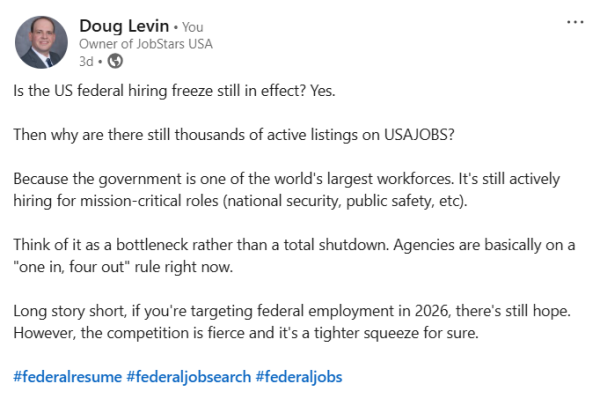
Below is a screenshot from a LinkedIn post I shared about the 2025-2026 federal hiring freeze.
Understanding Mandatory Exemptions
To understand why USAJOBS stays active during a freeze, you have to look at Mandatory Exemptions.
These are ‘get out of jail free’ cards for specific types of jobs. No matter what a headline says about a hiring freeze, the government is legally required to keep certain roles filled to prevent a national crisis.
When you see thousands of listings on USAJOBS during a federal hiring freeze, it’s usually because those announcements fit into one of these protected categories:
-
Life and Safety: This includes doctors and nurses at VA hospitals, air traffic controllers, and weather forecasters. These roles are exempt because if they go unfilled, the public is put in immediate danger.
-
National Security: This covers the FBI, Border Patrol, and critical roles within DOW. The government will not freeze those responsible for protecting the country or its digital infrastructure.
-
Legal Mandates: Sometimes, a law or a court order forces an agency to hire. For example, if a judge orders a department to fix a backlog in benefits, that department may be granted a special hall pass to hire the staff needed to meet that legal obligation.
The One In Four Out Rule
It sounds backward, but people leaving the government is exactly what keeps the door open for you. In the federal world, this is called attrition.
Think of a hiring freeze like a crowded elevator with a strict capacity limit. If no one ever gets off, no one new can ever get on. Attrition is simply people ‘getting off the elevator’ by retiring, moving to the private sector, or changing careers. Even during a freeze, the government uses these departures to shrink the workforce.
This refers to the ‘One In, Four Out’ rule. For every four people who leave an agency, that agency is allowed to bring one new person in. Because the federal government is so massive, thousands of employees retire or quit every single month. This means there is a constant, steady stream of vacancies being created.
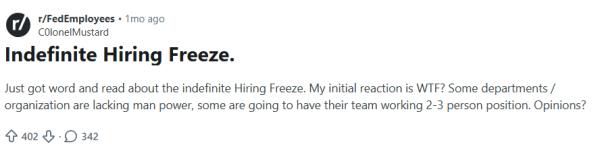
Below is a screenshot from a Reddit forum discussing the indefinite hiring freeze.
Getting Hired During a Freeze
Yes, it is still possible to get hired during a hiring freeze—but it is a much tighter squeeze.
A freeze does not shut hiring down entirely. What it does is compress the process. Fewer openings move forward, fewer candidates advance, and agencies become far less flexible about fit. Roles that are posted are typically ones the agency feels compelled to fill, not roles created for convenience or future growth.
That tighter environment raises the bar for candidates. Hiring managers are less willing to overlook gaps, make assumptions about potential, or take risks. You are not competing to be ‘good enough’. You are competing to be the clearest, safest choice in a constrained system.
The review process also becomes more cautious. Decisions move more slowly, involve more stakeholders, and require stronger justification at every step. From the agency’s perspective, each hire must be defensible, deliberate, and aligned with current priorities.
Bottom line: a hiring freeze narrows the funnel, but it does not eliminate it. Candidates who understand that reality (and tailor their positioning accordingly) can still get hired during a federal hiring freeze.
In Conclusion
In conclusion, I hope this articles helps with answering this question: Does the Federal Government Hire During a Hiring Freeze? The simple answer is yes. Even when the “freeze” is on, the mission doesn’t stop. The door is never truly locked. However, it is a much tighter squeeze that tends to reward the top candidates.
If you’re ready to build your new two-page Federal Resume, my team and I are here to support you. Please use the Contact Us or Submit Your Resume for a risk-free evaluation. JobStars is an A+ BBB-rated service that has earned multiple consecutive Complaint Free Awards. We look forward to hearing from you!
About the Author: Doug Levin