

Career Snapshot: Emergency Management Directors
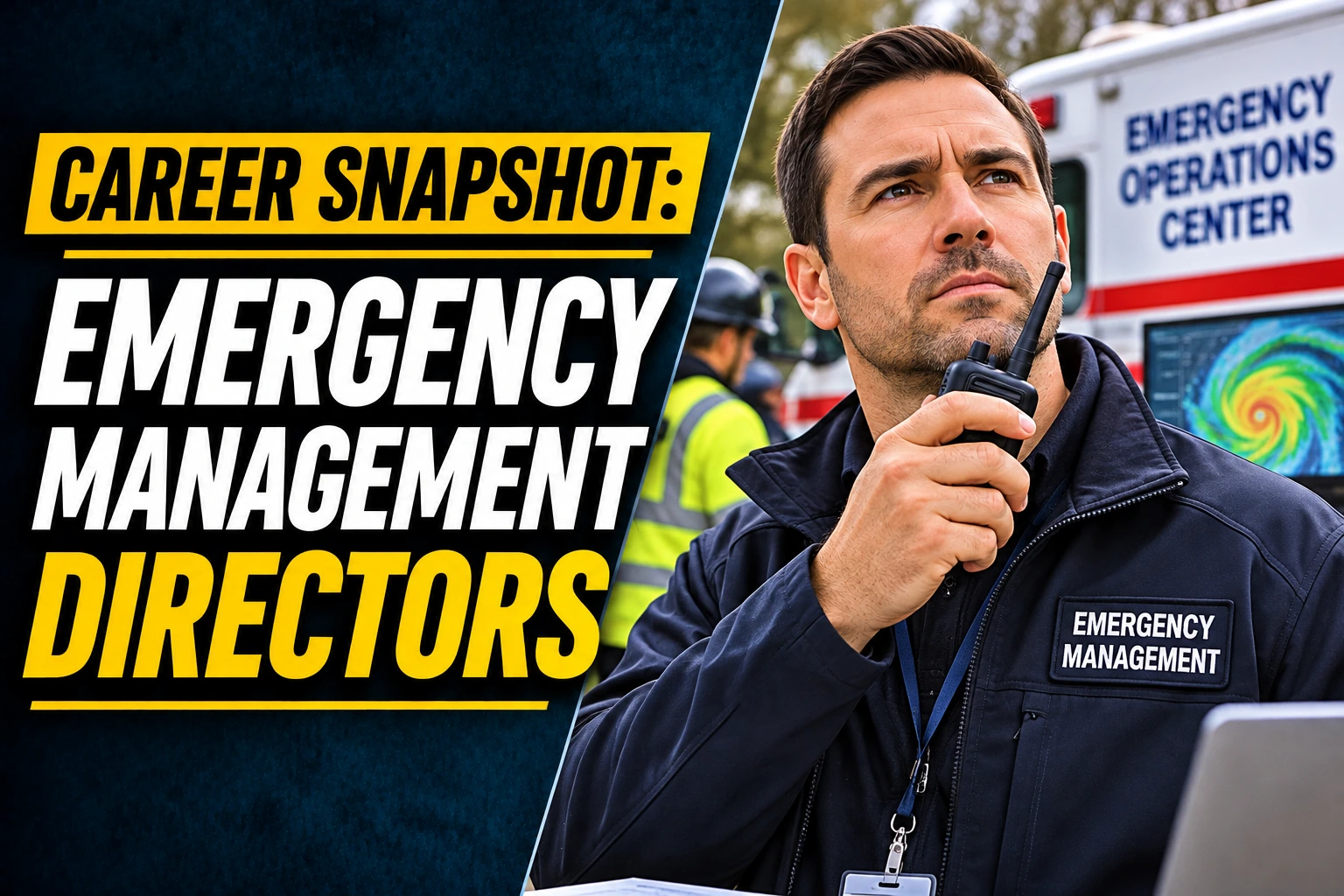
The following post features a Career Snapshot of Emergency Management Directors.
When a hurricane approaches, a wildfire threatens a community, or a major emergency disrupts everyday life, someone has to make sure people know what to do and that the right resources are ready to respond.
Read: How to Handle Getting Ghosted After an Interview
Career Snapshot: Interpreters and Translators
Have you ever considered a career centered on preparing for the unexpected and helping communities navigate their most challenging moments? Emergency management is a field that combines leadership, planning, problem-solving, and public service.
Here’s what you need to know about pursuing a career in this field.
Overview
Emergency Management Directors develop plans and procedures for responding to natural disasters, public safety threats, and other emergencies. Their goal is to minimize risks to people and property while helping communities and organizations maintain essential operations.
The role involves considerable coordination. Directors work with police and fire departments, emergency medical services, government agencies, nonprofit organizations, private businesses, and community groups to make sure everyone understands their responsibilities during an emergency.
Some professionals work in the private sector as Business Continuity Managers, focusing on helping organizations maintain operations and minimize financial losses during and after a disruption.
What They Do
Emergency Management Directors assess potential hazards, develop emergency response plans, coordinate training exercises, and identify the personnel and equipment needed to respond effectively. They also review existing procedures to make sure they meet applicable regulations and reflect current risks.
When an emergency occurs, directors may help manage operations from a command center, coordinate evacuations and rescue efforts, arrange public shelters, and communicate important information to the public. Afterward, they assess damage, coordinate assistance, and identify improvements for future response efforts.
The position requires more than planning. Directors must be prepared to make difficult decisions, communicate clearly, and coordinate multiple agencies during stressful and time-sensitive situations.
Work Environment
Emergency Management Directors held approximately 14,000 jobs in 2025. Most work for local or state government, although opportunities are also available in hospitals, educational institutions, and professional services organizations.
Although much of the work takes place in an office, directors regularly travel to meet with public safety officials, government agencies, businesses, and community organizations. They may also visit facilities to evaluate emergency procedures and oversee training exercises.
This isn’t necessarily a traditional nine-to-five position. Most directors work full time and are on call, sometimes around the clock. Emergencies can require overtime, evening or weekend work, and the ability to respond under stressful conditions.
Education & Training
Emergency Management Directors typically need a bachelor’s degree in emergency management, security and protective services, business, or a related field. Those working in business continuity management may benefit from a degree in computer science, information systems, or another technology-related discipline.
Education is only part of the equation. Employers generally look for several years of related experience in areas such as law enforcement, fire safety, military service, emergency response, or disaster planning. This background helps candidates develop the judgment and leadership skills needed to coordinate emergency operations.
Some states require directors to obtain certification after being hired, while employers may prefer or require credentials such as Certified Emergency Manager (CEM) or Certified Business Continuity Professional (CBCP). Strong communication, critical-thinking, decision-making, interpersonal, and leadership skills are also important.
Salary Expectations
According to the U.S. Bureau of Labor Statistics, the median annual wage for Emergency Management Directors was $93,330 in May 2025. The lowest 10 percent earned less than $54,210, while the highest 10 percent earned more than $166,430.
Compensation can vary considerably depending on the employer and industry. For example, the median annual wage was $136,930 in professional, scientific, and technical services, compared with $84,630 for local government and $79,190 for state government.
Experience, education, certifications, and the scope of an organization’s emergency management responsibilities can all influence earning potential.
Career Outlook
Employment of Emergency Management Directors is projected to grow 4% from 2025 to 2035, about as fast as the average for all occupations. The BLS projects approximately 1,100 openings each year over the decade.
The continued need to prepare for natural disasters, public safety threats, and other disruptions should help sustain demand. Businesses and organizations also need professionals who can protect essential services and coordinate recovery efforts when emergencies occur.
However, opportunities in local and state government can depend on available funding. Some communities may assign emergency management responsibilities to existing fire chiefs, police chiefs, or other officials rather than hiring a dedicated director.
Resume Considerations
When you’re building a resume for an Emergency Management Director position, highlight experience developing emergency response plans, coordinating disaster preparedness efforts, managing resources, and leading teams through challenging situations.
Accomplishments involving emergency exercises, successful response operations, risk reduction, interagency coordination, or recovery efforts can help demonstrate your qualifications. Quantify the scope of your responsibilities whenever possible.
Relevant education, certifications, and public safety experience should also be clearly identified. Employers may look for credentials such as CEM or CBCP, along with experience in emergency operations, disaster recovery, business continuity, crisis management, and risk assessment.
Keywords such as emergency preparedness, incident management, resource coordination, emergency response planning, and continuity planning frequently appear in job descriptions.
In Conclusion
In conclusion, I hope you find this post helpful for understanding Emergency Management Directors. If you enjoy leadership, problem-solving, public service, and helping people prepare for challenging situations, emergency management offers an opportunity to make a meaningful difference in the safety and resilience of communities and organizations.
If you’re ready for professional assistance with building your ATS-friendly and visually appealing Resume, my team and I are here to support you. Please visit Resume Writing or Submit Your Resume for a risk-free evaluation. We look forward to hearing from you!
About the Author: Doug Levin